
news
Jefferies warns of a "2008 moment": AI may lead to a "capital apocalypse" in the United States, with market share shifting to Chinese open-source models.
Debt risks in the AI sector are prompting intensive warnings from veteran Wall Street strategists. In his latest quarterly report, Chris Wood, head of global stock strategy at Jefferies (Jefferies) and author of GREED & fear, compared the current AI boom with the 2008 subprime mortgage crisis and raised a structural hidden danger: ultra-large cloud vendors are providing huge amounts of "unsecured credit" to two AI laboratories that continue to lose money ".
According to Wood:"The most likely long-term outcome of AI story at the market level will be the massive destruction of capital in the United States, with market share going to the cheaper Chinese open source big language model."
AI story "will have a major reset at some point in the near future".
China Model: From "Cheap" to "Equivalent"
Wood's warning is not new, but the scale is escalating.
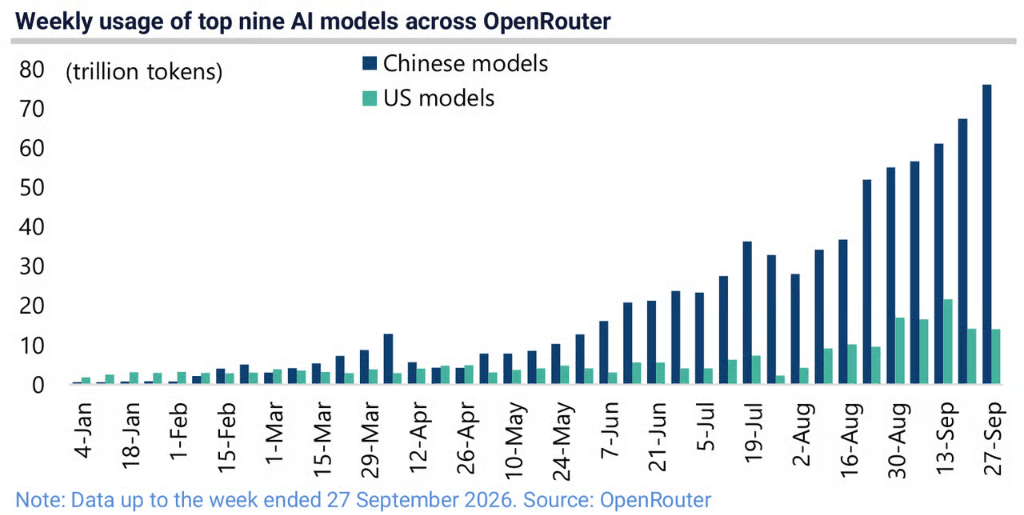
The OpenRouter data he tracked showed that as of the week of September 27, China's top models had processed 76.12 trillion tokens, compared with 4.37 trillion at the end of April this year. During the same period, the processing capacity of the top model in the United States was 14.2 trillion token. China's numbers have doubled in ten weeks.
The quality level has also changed. Wood noted that Moonshot's Kimi K3 "is 'competing at the cutting edge, 'in AI industry terms, with performance estimated at 95 percent of the Anthropic Claude Fable 5". Models that achieve 95% performance at a very low price are no longer discount brands, but real competitors.
The consequences of the price are already apparent. According to Silicon Data's LLM Token Expenditure Index, the average market price of AI tokens has fallen 52% since its high in May to a historical low of $0.98 per million token.
Credit Concentration Risk Behind U.S. 2.3 trillion Backlog Orders
Wood analogized the credit risk of the AI boom to the 2008 real estate crisis.The logic is as follows:
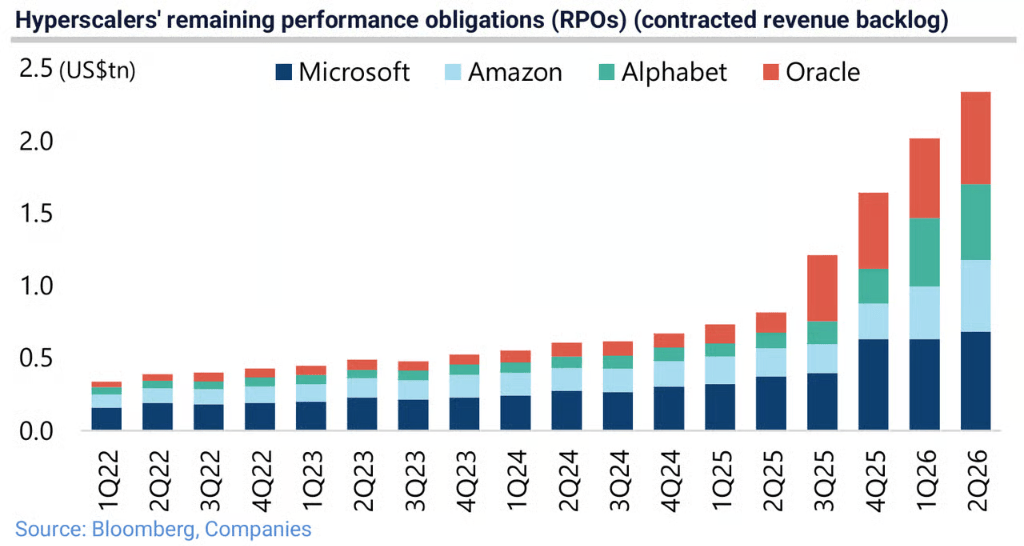
As of the end of the second quarter of 2026, the combined remaining performance obligations (RPO) of the four major platforms of Microsoft, Google, Amazon, and Oracle amounted to $2.34 trillion, an increase of 186 percent from a year ago and an increase of approximately $1.52 trillion.
The problem is that about half of this huge order is owed by OpenAI and Anthropic-neither of which is currently profitable.
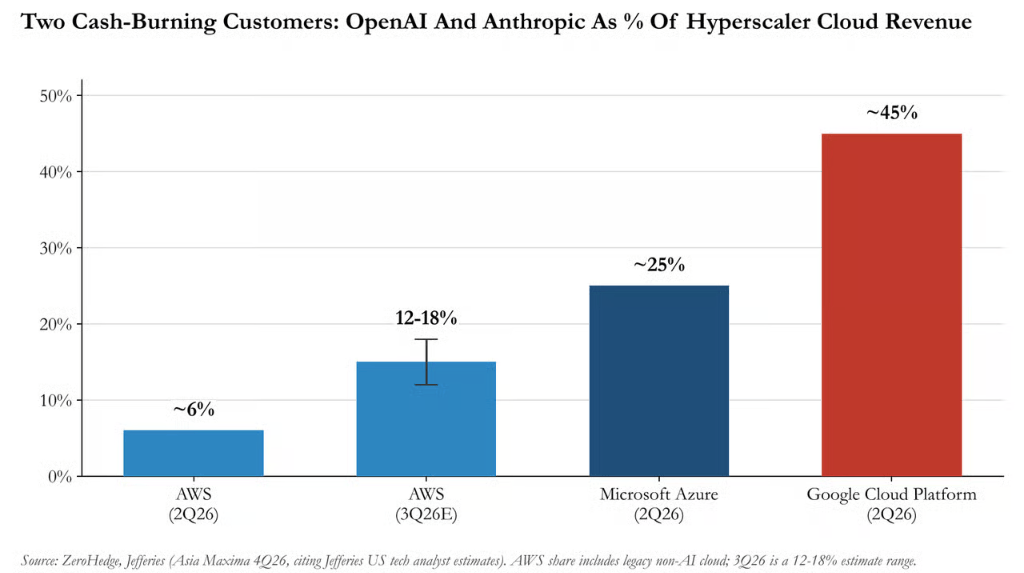
Wood writes, "Hyperscale cloud vendors are effectively providing centralized unsecured loans to tenants who are still burning money, because Anthropic and OpenAI are not profitable. For emerging cloud service providers (neo-clouds), the risk is greater, because they themselves borrow money to rent chips."
Jeffrey Technology analysts estimate that the two cutting-edge AI laboratories will account for about 45% of Google's cloud platform revenue and 25% of Microsoft's Azure revenue in the second quarter of 2026, and their share in AWS is expected to double from 6% to 12%-18% in the third quarter.
Wood's analogy is direct and sharp: "Hyperscale cloud vendors' investments in data centers are based on the promise of assuming future payments from tenants-the same as the 2008 real estate credit crisis."
Off-balance sheet liabilities: another layer of hidden risk
Wood also points to the risk layer off the balance sheet.
According to Moody's statistics in February this year, the data center lease commitments of the five large-scale cloud vendors that have not yet started reached 662 billion US dollars, compared with only 152 billion US dollars at the end of 2023. A Nikkei study estimated the "hidden debt" of the five companies at the end of the second quarter of 2026 at $1.65 trillion, about $1.35 trillion more than their book debt.
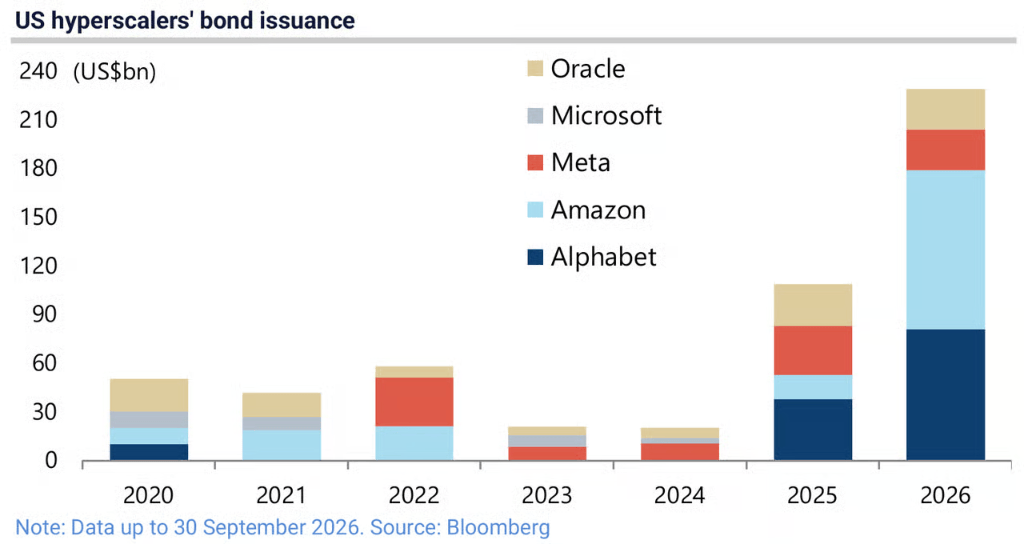
At the same time, the top five hyperscale cloud vendors have issued $229 billion in bonds this year, compared to $108 billion for all of 2025. Wood noted that credit spreads for Amazon, Google and Meta have risen 13 to 16 basis points since early June, and that "the need for long-term financing from hyperscale cloud vendors is competing with the federal government".
He concluded that the credit spreads of AI-related borrowers "must now be closely monitored to see if investors begin to be reluctant to finance AI capital expenditures" and that securitization of data center assets is "an area that needs to be focused on".
The Truth About Profit: Circular Financial Engineering?
Wood's questioning of the quality of earnings for hyperscale cloud vendors is perhaps the most impactful part of the report.
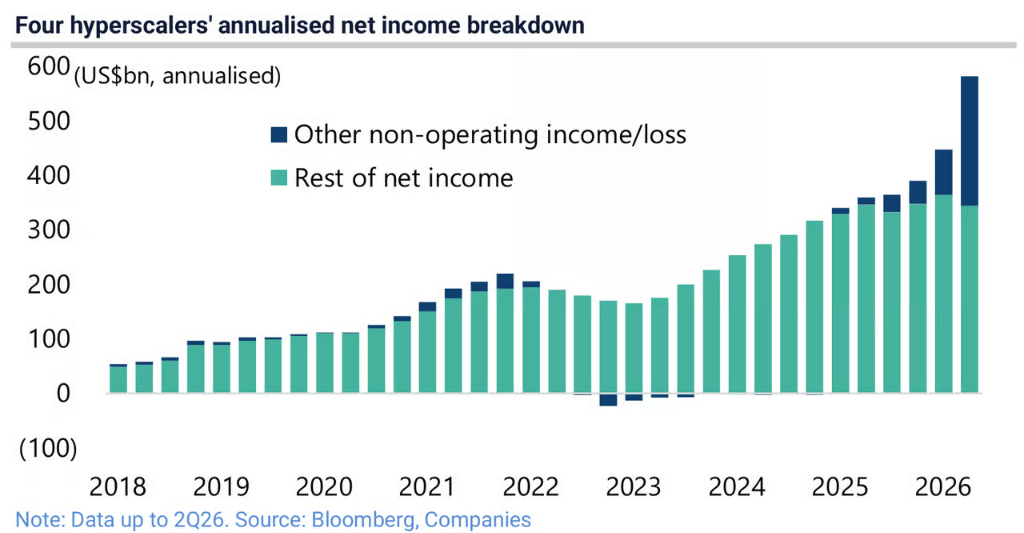
The data shows that in the four quarters ending in the second quarter of 2026, the annualized profit of the four major ultra-large-scale cloud vendors increased by US $222 billion to US $581 billion. However, the "other non-operating income/loss" account, which captures unrealized floats on equity investments in unlisted companies, increased by $224 billion over the same period.
In other words, the entire increase in the profits of hyperscale cloud vendors can be explained by the mark-to-market floating earnings on the equity of AI startups.
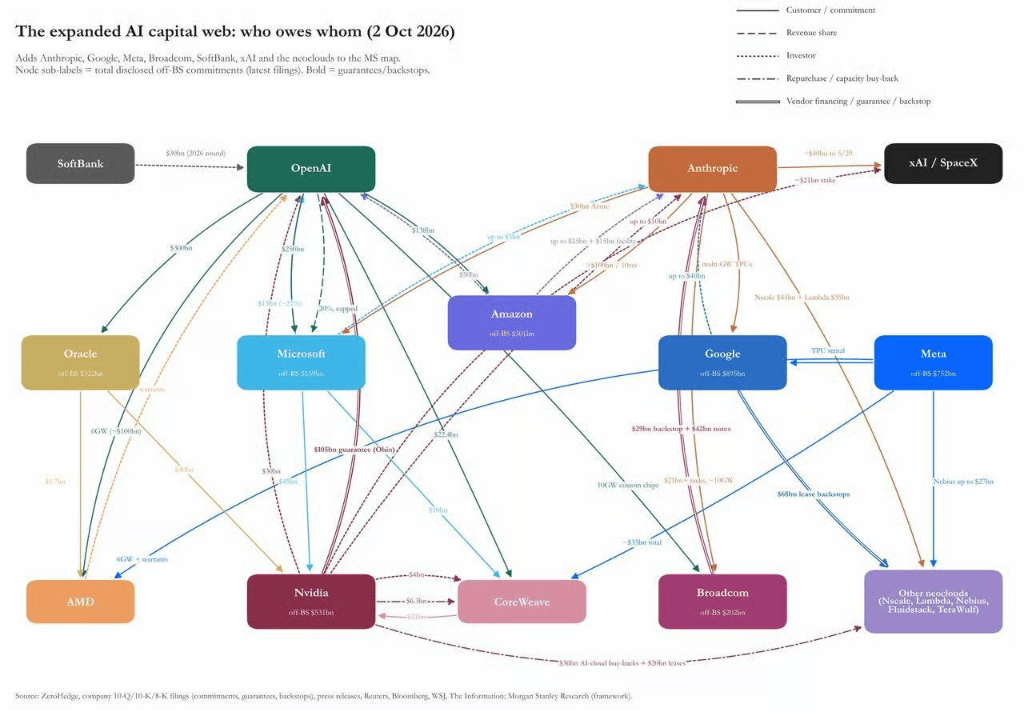
Wood describes the logic of this cycle: hyperscale cloud vendors invest in AI labs, AI labs buy computing power from the same group of hyperscale cloud vendors, and hyperscale cloud vendors then count the higher private equity valuations of labs in their profits.
He also pointed out that the S & P 500 report EPS growth of 18% annualized over the past three years, while the national accounts of non-financial corporate profits increased by only 5%. The last time there was such a big divergence was at the peak of the dotcom bubble. Wood wrote: "The above indicates the existence of financial engineering."
Capital Expenditure: Who Will Pay?
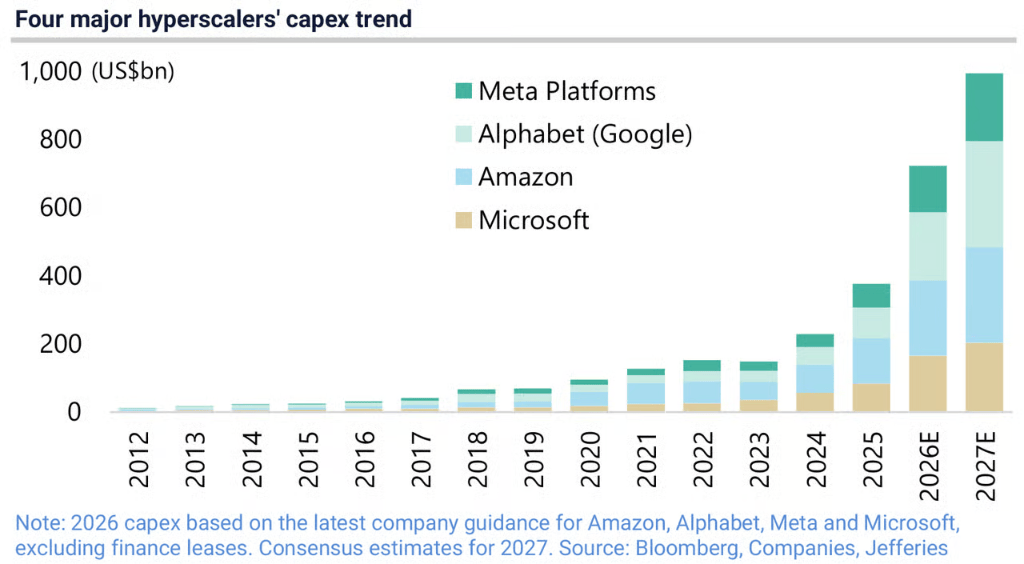
Although free cash flow has plummeted from $60 billion in the fourth quarter of 2025 to $7 billion in the second quarter of 2026 and is expected to turn negative to $13 billion in the third quarter, capital expenditures have not slowed.
Market consensus predicts that the capital expenditure of the four major hyperscale cloud vendors will rise from $723 billion this year to $993 billion in 2027.
Wood's question is direct: "Are these four hyperscale cloud vendors really going to spend $993 billion in capital expenditure in 2027? This is the current market consensus estimate."
His baseline scenario is:AI story "will have a major reset at some point in the near future".
"Security" or cartel?
Wood's interpretation of the recent call for a "safety pause" in the AI industry is equally interesting.
Anthropic's Dario Amodei, OpenAI's Sam Altman and Elon Musk recently called for a slowdown in cutting-edge AI development, but Trump immediately refused.
Wood disagrees with the "safe" rhetoric, writing: "It is advisable to focus on incentives. A coordinated moratorium in the name of 'safety' could be seen as a way to build a regulatory moat, especially if subsequent plans ban open source models, especially from China. Another possibility-and the two are not mutually exclusive-is that the AI giants have realized that the cost of computing is becoming unsustainable, and/or the demand for models is starting to level off. If so, why not try to lock down a cartel now?"
It is worth noting that Meta's Mark Zuckerberg rejected the call to slow down, and Meta's share price has since risen 18%.
The credit market is key.
Wood's investment proposal has not changed since 2023: hold "picks and shovels" (I. e., chipmakers that charge capital expenditures to hyperscale cloud vendors), rather than hyperscale cloud vendors themselves. This strategy is effective during the period of continuous purchase by the buyer.
But he believes that it will be the credit market, not the stock market, that will determine when all this ends.
His conclusion:"The AI ecosystem is currently issuing more long-dated bonds than the U.S. Treasury, in an environment of bond market volatility and Fed rate hikes, funds for data center construction, and the largest tenants continuing to lose money."
Citing the historical analogy of the 1997 Asian financial crisis-a similar framework was proposed by SocGen's Albert Edwards at the same time-Wood points out that Thailand's "miracle" ended not because of productivity disappointments, but because creditors noticed the problem.
Novogratz said the bubble was 'not spectacular enough' to burst. Wood says it doesn't have to be spectacular: just run out of people willing to lend.
Recommended News
Contact Us
- Phone: 0017194050155
- Fax: 0017194050155
- 邮箱:gelcc1@outlook.com
- Mobile phone: 0017194050155
- Address: Room 500, 1234 International Avenue, Washington, D.C. 20001, USA