
news
Winter is coming, and Europe is once again facing an “energy crisis.”
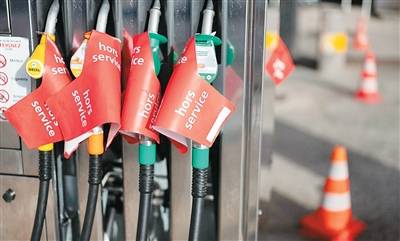
This is a decommissioned fuel nozzle, photographed recently in Quimper, western France. Xinhua News Agency/AFP
As winter approaches, energy risks in Europe are becoming increasingly pronounced. European Commission President Ursula von der Leyen recently stated at the European Parliament that, since the end of February this year, European natural gas prices have risen by about 140%, diesel prices have doubled, and expenditures on imported fossil fuels have increased by an additional approximately €100 billion. As winter approaches, the pressure on businesses and households caused by high energy costs may further intensify. At the recent EU summit held in Brussels, Belgium, the first item on the agenda was addressing the energy crisis.
Since the outbreak of the Russia-Ukraine conflict in 2022, the energy crisis has remained a “Damoclean sword” hanging over Europe. Can Europe get through the “energy crisis” this winter?
“A price crisis concerning energy supply”
On October 13, local time, the price of natural gas futures at the Dutch Title Transfer Facility, the benchmark for European natural gas, surged past €86 per megawatt-hour, reaching its highest level since December 2022. Meanwhile, natural gas storage levels in Europe stand at 73.75%, significantly below the average for this time of year, with Germany’s storage rate at only about 58.7%.
A recent report by the U.S.-based Institute for Energy Economics and Financial Analysis indicates that, as conflicts in the Middle East continue to disrupt global energy supplies, the European Union could face a natural gas supply shortfall of up to 14 billion cubic meters this winter—roughly 7% of the EU’s total demand, equivalent to the energy needs of more than 10 million European households.
Sun Yanhong, Director of the European Economic Research Office and a researcher at the Institute of European Studies of the Chinese Academy of Social Sciences, pointed out in an interview with this newspaper that Europe’s low natural gas inventories indicate limited room to buffer against winter cold snaps and surges in energy demand, and the subsequent demand for restocking could further drive up natural gas prices. At the same time, Europe has long been highly dependent on natural gas imports, and in recent years, as pipeline gas supplies have become more constrained, its reliance on liquefied natural gas imports has increased, making its costs more susceptible to geopolitical conflicts. Furthermore, as winter approaches, liquefied natural gas demand across Asian countries is also expected to rise broadly, which will to some extent drive up global LNG prices and, in turn, boost natural gas prices in the European internal market.
Diesel prices are also fluctuating at high levels. According to data released by the European Commission on October 1, the average diesel price in the EU has reached a record high of €2.24 per liter, compared with €1.59 per liter before the outbreak of conflict in the Middle East. Among them, 12 EU member states, including Belgium, Italy, Romania, and Poland, have seen diesel prices reach record highs.
Sun Yanhong analyzed that Europe’s refining capacity has been shrinking for a long time, leading to a high dependence on external diesel supplies. Following the outbreak of the Russia-Ukraine conflict, Europe adjusted its diesel import sources, relying primarily on suppliers in the United States and the Middle East. However, recent developments have dealt multiple blows to its imports: the conflict in the Middle East has led to a sharp decline in diesel exports from the Gulf region, while U.S. supply has also tightened, making it difficult for Europe to secure sufficient import volumes. Furthermore, factors such as damage to refineries in the Middle East, frequent Ukrainian attacks on Russian refining facilities, and a decline in U.S. refining and refined‑product exports have collectively tightened global diesel supplies, driving up import and sales prices in Europe.
Recently, EU Energy Commissioner Dan Jørgensen wrote to the energy ministers of EU member states, warning that Europe “is facing a price crisis that threatens energy supplies,” and urging countries to continue replenishing their gas storage. He also suggested reducing natural gas and electricity demand when necessary, and even proposed specific energy-saving measures such as limiting indoor temperatures in public buildings and shutting down outdoor heating equipment.
“Europe’s vulnerability has remained consistent.”
The Belgian website “Social Europe” recently published an article stating that, in just four years, Europe has faced crises over the same issue twice: in 2022, the Russia-Ukraine conflict left the EU without affordable Russian oil and gas; this year, disruptions in the Strait of Hormuz have once again dealt a severe blow to Europe. “While the external circumstances may differ, Europe’s vulnerabilities remain unchanged.”
In recent years, Europe’s energy supply has been repeatedly disrupted by geopolitical conflicts and fluctuations in the international market, leading to a marked increase in its reliance on the United States. According to the latest data from Kepler, an international market research firm, since the beginning of 2026, the EU has been importing an average of approximately 580,000 barrels of diesel per day, with the United States supplying about 180,000 barrels, accounting for roughly 32%—a share that stood at only 17% in 2025. In Northwest Europe, U.S. supplies account for approximately 57% of the region’s diesel imports, up from just 37% last year. According to data from S&P Global Energy, the United States is expected to export an average of approximately 360,000 barrels of diesel per day to Europe in the third quarter of this year, up from about 250,000 barrels per day before the Middle East conflict. In August, U.S. diesel accounted for 62% to 72% of the total diesel imports in the United Kingdom and the Netherlands.
Not long ago, the United States pressured Europe by imposing a “diesel export ban,” urging it to release its diesel reserves. Subsequently, the Group of Seven (G7) issued a joint statement announcing that it will release 100 million barrels of crude oil from its reserves over the next 120 days. Sun Yanhong analyzes that this not only exposes the risks associated with Europe’s over-reliance on external markets for energy supplies, but also reflects the complex reality in which global energy trade and geopolitical competition are intertwined. At a deeper level, U.S. coercion will also make Europe realize that reducing dependence on a single supplier does not equate to achieving energy independence. Without sufficient domestic supply capacity and genuine diversification safeguards, new dependencies are likely to evolve into new strategic vulnerabilities.
The outlook for natural gas is also not optimistic. The EU’s comprehensive ban on imports of Russian liquefied natural gas will take effect at the beginning of 2027, at which point Europe’s natural gas imports are expected to decrease by an additional approximately 7 billion cubic meters. If the shortfall is covered by LNG imports from the United States, the additional cost at current prices would be about €3 billion, a 12% increase compared to last year. Moreover, U.S. liquefied natural gas production is already operating near full capacity, leaving limited room for additional supplies to Europe, which further complicates Europe’s efforts to close its natural gas supply gap.
Some European media have pointed out, “A continent that still has to keep an eye on energy prices before deciding on the red lines of its foreign policy clearly cannot be considered truly sovereign.”
Sun Yanhong believes that the European energy system still has numerous structural shortcomings—
First, traditional fossil energy resources are relatively scarce, and the country has a high degree of dependence on imports. The European Commission projects that fossil fuels will continue to dominate the EU’s energy consumption structure through 2030, implying that the EU will find it difficult to reduce its reliance on external energy sources in the medium to short term.
Second, energy infrastructure and storage capacity are significantly inadequate. At present, some EU member states have limited gas and oil storage capacities. Trans-European cross-border pipeline and grid interconnections, as well as renewable-energy‑compatible energy storage facilities and power system flexibility, urgently need to be enhanced. This means that Europe’s tools for managing short- and medium-term energy supply–demand imbalances are relatively limited.
Third, there is a contradiction between policies promoting the development of renewable energy and those governing foreign economic and trade cooperation. On the one hand, the EU seeks to enhance its energy independence through renewable energy; on the other hand, it is pursuing “de-risking” measures vis-à-vis China, concerned about over-reliance on China in the new-energy supply chain. This dual stance has also slowed its energy transition and constrained its room for greater energy autonomy.
Energy independence and the energy transition remain long-term and arduous tasks.
Preliminary data released recently by the European Union’s statistical office show that in September 2026, the euro area inflation rate rose to 3.8%, up 0.6 percentage points from 3.2% in August, marking the highest level since September 2023. Among them, energy prices rose 18.8% year on year, with the increase widening further from August, making them the primary driver of rising inflation.
Boris Vujčić, Vice President of the European Central Bank, warned that insufficient global refining capacity and supply disruptions caused by geopolitical conflicts could keep diesel prices persistently high, further transmitting upward pressure to the prices of goods and services and intensifying inflationary pressures in the euro area.
Sun Yanhong analyzes that the continued rise in energy prices will impact the European economy through multiple channels. In the short term, rising natural gas and diesel prices will increase household heating, transportation, and living costs, as well as enterprise production and logistics expenses and agricultural input costs, which will then be passed on to food and other commodity prices, exacerbating inflationary pressures. In the medium to long term, sustained inflation will constrain consumption and investment, while also limiting the European Central Bank’s room for monetary easing, thereby dampening economic growth and potentially further weakening Europe’s industrial competitiveness.
How should Europe respond to the “energy crisis”? Some European media outlets have noted that deep divisions currently exist within the EU regarding energy issues. Countries with a higher reliance on fossil fuels, such as Poland, Italy, and the Czech Republic, are calling on the European Union to relax fiscal rules and implement “targeted measures” to provide funding to alleviate the energy crisis; some countries have even advocated for easing constraints on the green transition. Meanwhile, against the backdrop of a diesel supply agreement between the United States and Russia, calls within the European Union to resume imports of Russian energy products have begun to emerge. However, Nordic countries, as well as Spain and Portugal—nations that have made substantial investments in renewable energy—are opposed to the EU deviating from its long-term goals of electrification and decarbonization.
Sun Yanhong believes that, in the face of an increasingly severe energy situation, the EU needs to strengthen coordination among its member states in the short term, rationally release existing reserves, accelerate stock replenishment, and implement targeted temporary measures to protect vulnerable households and critical industries, while also enhancing energy efficiency and demand-side management. In the medium to long term, we should accelerate the development of renewable energy, enhance the capacity and efficiency of energy storage systems, and expedite the construction of smart grids, while also promoting the electrification of transportation, heating, and industrial energy use.
“Furthermore, Europe needs to strike a balance between accelerating the energy transition and assessing supply-chain security risks. In the current volatile international environment, truly enhancing energy security hinges on speeding up the development of renewable energy, bolstering domestic energy self-sufficiency, and reducing structural reliance on external fossil fuels.” Sun Yanhong said.
Recommended News
Contact Us
- Phone: 0017194050155
- Fax: 0017194050155
- 邮箱:gelcc1@outlook.com
- Mobile phone: 0017194050155
- Address: Room 500, 1234 International Avenue, Washington, D.C. 20001, USA