
news
The United States Customs Knives at T11 Customs Clearance! To push "low-value goods" declaration of new rules!
The U.S. is once again increasing its regulation of low-value parcels!
After cutting off the $800 minimum exemption (T86 customs clearance), wave your knife again to T11 customs clearance!
It is reported that on October 8, local time, the United States Customs Service (CBP) published a Notice of Proposed Rule Making (NPRM) in the Federal Register--Low-Value Shipments。
The core content of this draft directly refers to the loopholes related to the "informal customs declaration process worth 2500 US dollars and below", and proposesReporting time, data transparency, margin (Bond) constraints.and other aspects to modify.
At the same time, the U.S. Customs also proposed to establish aNew electronic informal entry type-T13(Entry Type 13)!
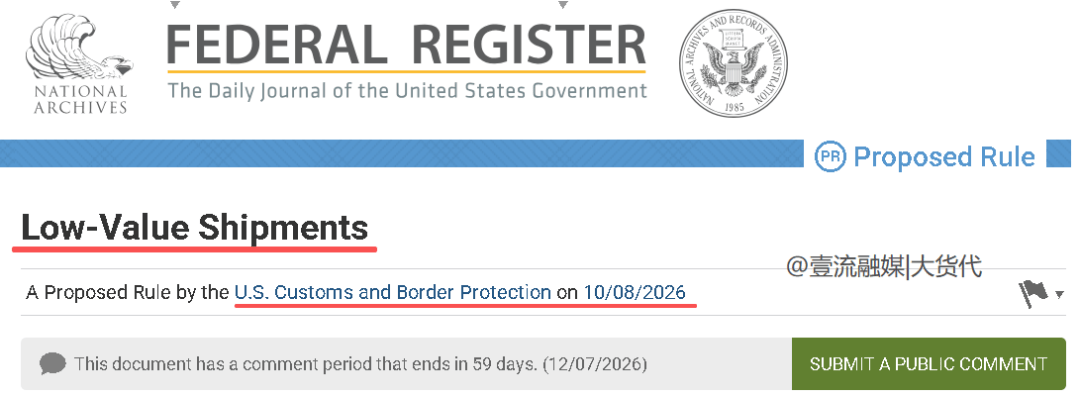
New rules for the declaration of "low-value goods" are proposed.
Judging from the content of the draft, the main reason why the US Customs intends to push this new regulation is to address the problem of "regulatory blind spots" in the customs.
IncludingMissing data, serious tax evasion and security and smuggling problems-- CBP data show that the compliance reporting rate of some cross-border postal channels is not ideal. A large number of packages are free from effective tax payment and inspection when imported. Compared with formal customs declaration channels, traditional informal and postal small package channels often become the hardest hit areas for contraband, infringing goods and even illegal drugs.
The new regulations proposed in this draft can be roughly divided into four items:
1. Reduced T11 Declaration Time Limit, New Data Requirements
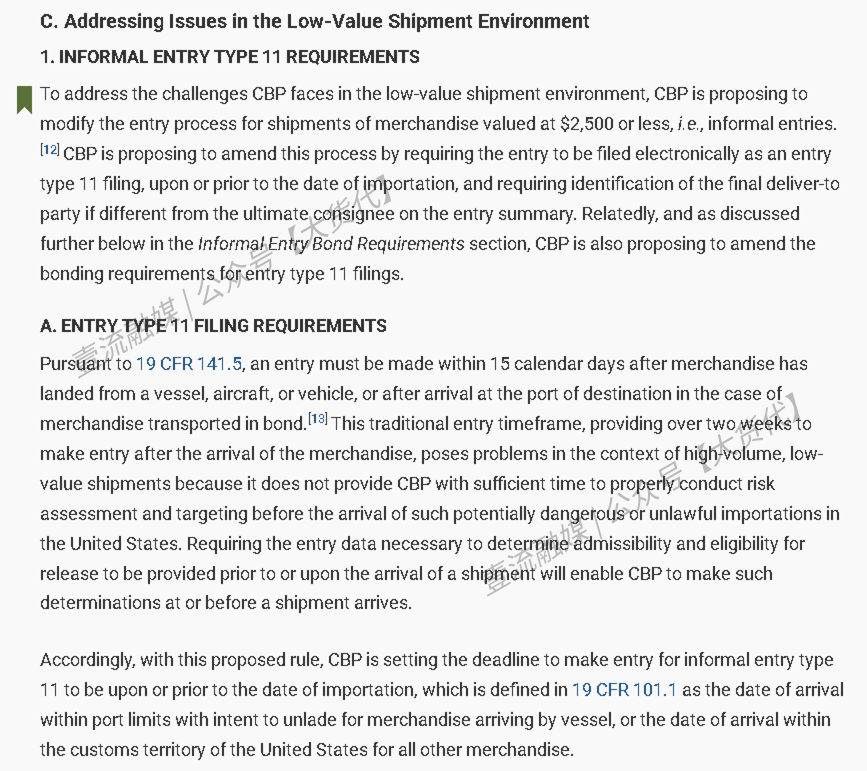
First of all, in terms of T11, the US Customs has put forward two requirements.
1. Time limit for declaration-- In the past, informal imports were usually allowed to be declared within 15 calendar days of arrival in the United States, leaving more room for fault tolerance for logisticians and cross-border sellers, but under the new rules, they were replacedIt is mandatory that "Informal Customs Declaration (ET11) for goods worth $2500 or less must be completed electronically on or before the date of import".
Simply put, it is to cut off the past "first to Hong Kong, then to make up the ticket" operation.
2. Data requirements-- In response to problems such as vague product names and general addresses, the United States intends to add a mandatory requirement to the ET11 informal declaration,The name and address of the final consignee/final delivery party in the United States must be truthfully filled in (if not the same subject as the customs declaration document).
If implemented, this means that in the past, some gray games that hid the real buyer information on the C side through "batch centralized customs clearance and domestic re-posting of orders and transshipment" will have a geometric increase in risk.
As for what happens if you don't comply? It's simple, and U.S. Customs has added an "automatic waiver mechanism".
If the package is stranded and overdue due to incomplete information, wrong tax number, etc., it will be regarded as abandoned under the new regulations-if the compliant electronic declaration is not completed within 15 days after import, low-value mail will be directly regarded as "voluntary abandonment" and will then be quickly destroyed or returned to the sender according to the procedures of the United States Postal Service (USPS)!
Although they are all 15 days, the previous 15 days are the "grace period for declaration" of the U.S. Customs (you can slowly supplement the information after landing); and the 15 days of the new regulations become an "ultimatum" (exceeding this period is tantamount to losing the right to goods).
2. Plugging Postal Loopholes and Adding "T13" Electronic Customs Declaration Type
Secondly, in addition to tightening the commercial express (T11), the postal parcel channel is also the top priority of the US Customs rectification.
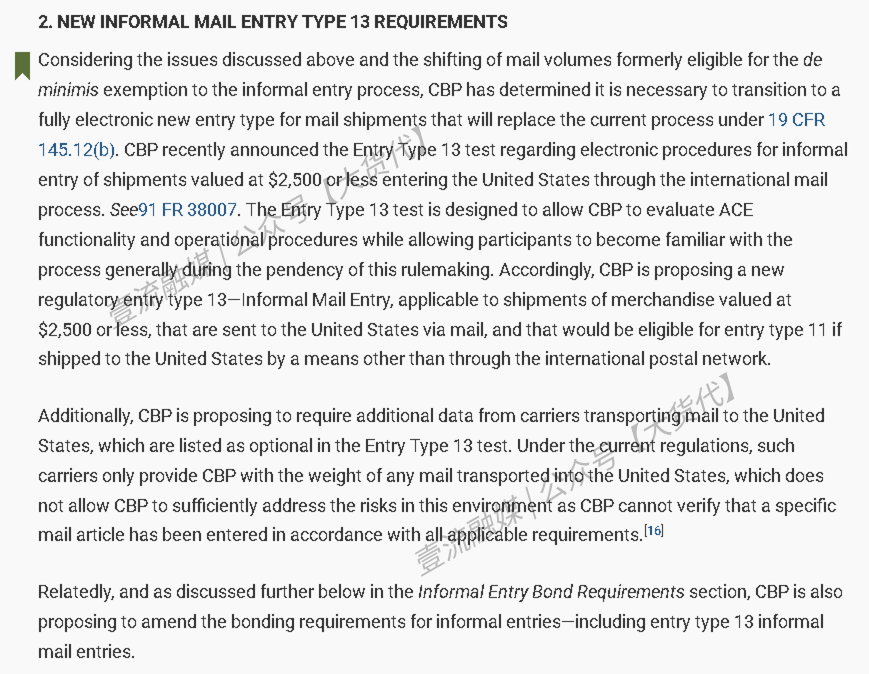
According to CBP, due to the relatively closed and vague customs clearance methods of the previous international postal network (USPS/Universal Postal Union system), it is difficult for customs to obtain structured and accurate data,CBP plans to launch a new T13(Entry Type 13, informal mail declaration).
In short, if T13 is launched, small packages entering the United States through postal channels in the future will not only have to submit core data including 10-digit HTSUS tax number, country of origin, value, etc. through ACE electronic system, but also be forced to bind UPU S-10 tracking number and sender identity information. The tracking number submitted by the carrier in the manifest must also be consistent with the customs declaration data.
What if the data is not right or not reported? After the package arrives in Hong Kong, it will be stuck in the same place and cannot be released...
3. mandatory requirement, change margin (Bond) to hard threshold
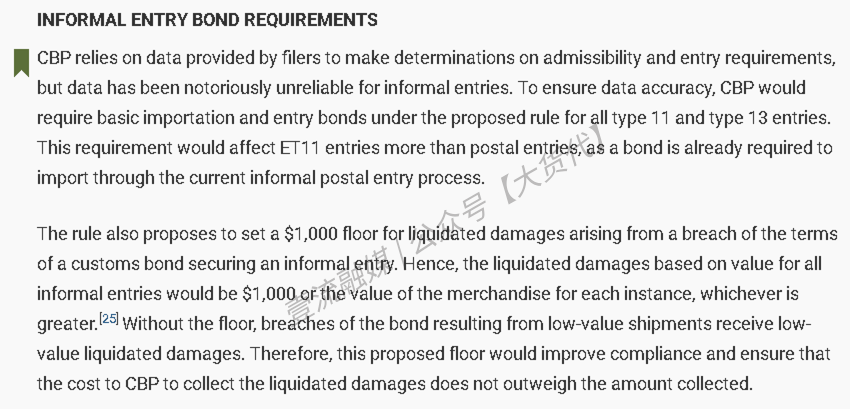
This item is mainly for the current informal customs declaration of many low-value goods, there is almost no fixed capital threshold, resulting in the lack of security of tax recovery.
Therefore, in the draft, U.S. Customs proposes that all T11 and T13 filers must obtain a valid basic import and entry bond (single or continuous Bond).
As for the punishment after violation, the current plan is:
Liquidation damages start at a minimum of $1000-an amount equal to the value of the goods or $1000, whichever is higher;
If restricted or specific goods are involved, the penalty is calculated at 3 times the value of the goods.
4. CBP can force goods to go to "official customs declaration"
Finally, in the draft, U.S. Customs also mentions its readiness to expand its discretion--The new rules are intended to allow CBP to directly target specific importers, specific categories of goods, specific manufacturers or specific sellers in the future, requiring them to withdraw from informal customs clearance as a whole and to force a more complex and more stringent formal customs clearance (Formal Entry).
According to the understanding of this article, it should be to improve CBP's power to dispose of marked importers, so that they can directly "one size fits all" high-risk subjects/categories, without having to slowly approve them one vote at a time.
Conclusion
Judging from the information currently released, if this draft is fully implemented, it will definitely be inevitable for shippers and freight forwarders to face the problem of rising compliance costs--The most intuitive, such as logistics costs, with the declaration of time front, data granularity becomes fine, freight forwarders and customs clearance banks must upgrade the system, increase data audit and customs clearance links, these additional technical and labor costs, will eventually be transmitted to the freight, customs clearance fees or other related costs.
But having said that, after all, the new regulations proposed by CBP are still in the stage of proposing and soliciting public opinions. It is still unknown how they will be implemented and whether there will be changes after they are officially implemented.
So it's the same sentence-shippers and forwarders can keep their attention and make plans in advance, but they don't need to be too anxious in the short term.
If you need to reprint, please be sure to indicate the source: WL123 cross-border navigation information
Recommended News
Contact Us
- Phone: 0017194050155
- Fax: 0017194050155
- 邮箱:gelcc1@outlook.com
- Mobile phone: 0017194050155
- Address: Room 500, 1234 International Avenue, Washington, D.C. 20001, USA