
news
Foreign media: The murder of the US military in Okinawa has aroused public indignation, and Japan's "pivot point to curb China" has added variables.
Hong Kong News Network, October 9 (Editor: Li Xueping) — The case involving a U.S. Marine stationed in Okinawa who is suspected of murdering a Japanese female citizen has sparked widespread public outrage in Japan. The Irish Times and other foreign media outlets have recently reported that the Japanese government intends to turn Okinawa into a strategic linchpin for containing China, but this recent murder case has introduced new uncertainties into those plans.
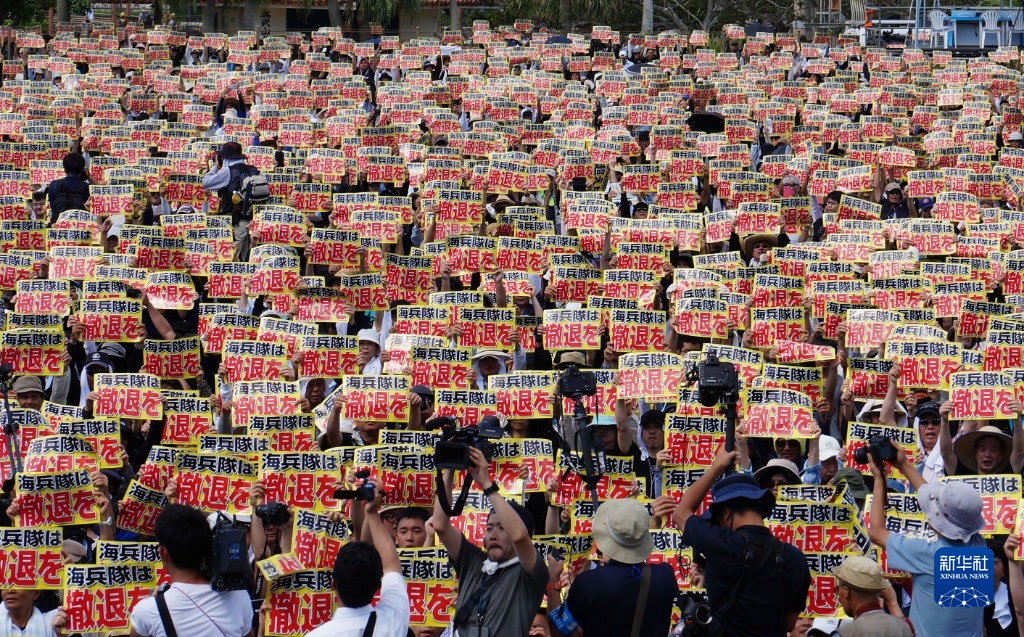
On the 6th, Japanese media disclosed details of the case: Devin Ballard, a 20-year-old U.S. soldier suspected of robbery and murder, is a member of the Marine Corps stationed at the U.S. Marine Corps Air Station Futenma in Okinawa. Police suspect that on the morning of October 3, Ballard strangled a Japanese woman to death using the telephone cord in her hotel room and then stole her wallet and other belongings. At present, the U.S. military soldier involved in the case has been transferred to the prosecution authorities.
The Tokyo Weekly reported on the 6th that the incident has once again drawn public attention to the past record of crimes and fatal accidents involving U.S. military personnel stationed in Okinawa—a long and painful history. According to Japanese media reports, since 1972, more than 6,000 U.S. military personnel and related individuals have been arrested by Japanese police, with 80 arrests in 2024—marking the highest annual figure in 20 years.
“The Japanese government has consistently placed the U.S.-Japan alliance above the safety, lives, and concerns of the people of Okinawa.” Professor Kozue Akibayashi of Doshisha University in Japan told Al Jazeera, “The U.S. and Japanese governments have consistently justified the presence of U.S. forces and the issue of their excessive concentration by citing the ‘geopolitical’ significance of the islands’ location.”
The Irish Times reported on the 7th that efforts to turn Okinawa into a key strategic pivot for Japan’s strategy to contain China are now facing greater obstacles due to the recent murder case. If the U.S. forces stationed in Okinawa were to be driven out, the associated strategic framework would collapse; therefore, Tokyo and Washington will closely monitor the reactions of the Okinawan public in the coming days and weeks.
Nikkei Asia reported on the 8th that this murder occurred at a critical juncture; if handled improperly, it could erode Okinawa residents’ confidence in the Naha municipal government and in Okinawa’s newly appointed governor, Onaga Denny, potentially undermining Prime Minister Sanae Takagi’s “Southwest Shift” strategy and straining U.S.-Japan relations. Gushe has expressed an open attitude toward expanding the activities of Japan’s Self-Defense Forces and the U.S. military in the region, and the Gao municipal government has long looked forward to collaborating with him.
When Denny Tamaki was elected governor of Okinawa last month, Britain’s The Economist published an article stating that the impact of the Okinawan election extends far beyond its borders. Located approximately 640 kilometers south of Japan’s main island of Honshu, the prefecture hosts the majority of U.S. military facilities in Japan and is situated close to Taiwan, making it a strategic cornerstone of the U.S.-Japan effort to “deter China.”
The article states that Gu Xie’s victory will make it easier for the Japanese government to push ahead with military expansion in the region. Japan is deploying more weapons in the Ryukyu Islands and seeks to increasingly repurpose civilian infrastructure for military use. An Okinawan governor who is more willing to cooperate with Tokyo could help reduce the political costs of these plans.
However, the article also points out that getting too close to Tokyo could pose risks for Gusai as well. Yō Hateruma, a lecturer in the Department of Regional Administration at the Faculty of Law at Okinawa International University, warned that although the issue of U.S. military bases was less prominent than economic concerns in this election, another accident or crime could once again bring the base controversy to the forefront. She said, “If such a situation were to actually occur, and if it meant having to confront Tokyo, would he—Gusé—stand on Okinawa’s side?”
The Irish Times reported that this murder case is the first major political test facing Governor Gusui since taking office, and he must quell public outrage over the incident amid ongoing protests in Okinawa. (The End)
Recommended News
Contact Us
- Phone: 0017194050155
- Fax: 0017194050155
- 邮箱:gelcc1@outlook.com
- Mobile phone: 0017194050155
- Address: Room 500, 1234 International Avenue, Washington, D.C. 20001, USA