
news
Why once-cool Europe is warming fastest
Recently, extreme high temperatures swept across Europe, with temperatures exceeding 40 degrees Celsius in many places. From France to Poland, all places continue to set historical high temperature records. Europe’s climate of mild winters and cool summers appears to be coming to an end amid the global warming trend. Some foreign media believe that Europe has become the fastest global warming continent.
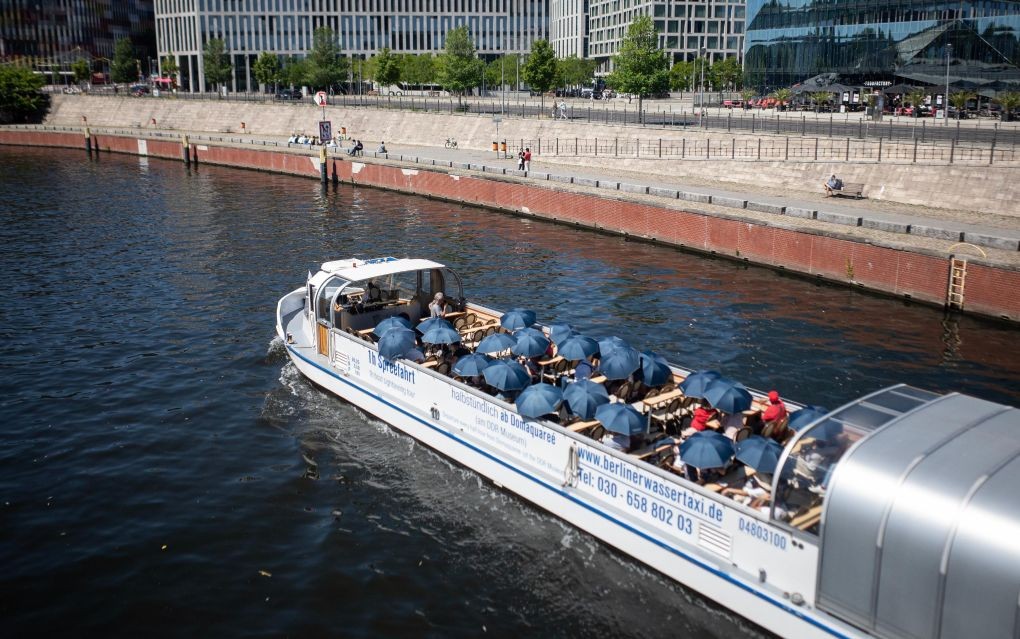
On June 24, in the German capital Berlin, tourists take an umbrella to take a cruise ship.
For Europe, where cool and comfortable weather was once the main feature, extreme heat is no longer a rare phenomenon. In mid-to-late June, the French province of Ronde monitored an extreme high temperature of 44.3 degrees Celsius. The French Meteorological Agency officially confirmed that June 22 was the hottest day since the country had meteorological records; more than 100 weather stations in Spain observed high temperatures above 40 degrees Celsius. Many places hit new highs in the same period; local temperatures in the UK exceeded 39 degrees Celsius, and temperatures in parts of Portugal and Spain approached 45 degrees Celsius. Southern and Western Europe are experiencing extreme heat, with many regions issuing the highest-level red alerts for high temperatures.
The French health department reported on the 28th that since June 24, the number of deaths caused by high temperatures in the country has exceeded 1000. The high temperature puts great pressure on the medical system of European countries, especially the emergency department. Some local emergency services are overcrowded.
According to data from the European Union's Copernicus Climate Change Service, temperatures in Europe have risen by about 0.56 degrees Celsius every ten years in the past 30 years, which is more than twice the global average. Europe is the fastest-warming continent. Of all the regions of the world, only the Arctic is warming faster than Europe.
Heatwaves in Europe are becoming more frequent, violent and persistent. Weather forecasts show that Europe may continue to experience abnormally high temperatures in the coming months, and the changes in atmospheric circulation caused by the El Niño phenomenon will further aggravate the high temperature situation. Europe had to adapt to a new climate.
Experts from several meteorological agencies have said that climate warming caused by human activities is the main reason. But why is it that only Europe is warming so fast?
The Bloomberg article believes that there are multiple special factors that have greatly accelerated the warming process in Europe. The first is that the atmospheric circulation pattern has changed. The circulation movement has allowed more hot air from the south to pour into Europe, creating more heat waves and extreme heat. In addition, the area covered by ice and snow in Europe continues to shrink, and the heat absorbed by the surface increases, which is also one of the reasons for the rapid warming of the region.
Regarding the cause of the high temperature in Europe, David Dehneau, a meteorologist at the Royal Meteorological Institute of Belgium, said that under the control of continuous high pressure, the "thermal dome" appeared. This strong high-pressure area is like "a huge pot cover", hindering the formation of clouds, allowing more solar radiation to reach the surface, and also pressing the warm air trying to rise back to the ground, forming a closed and difficult to break the vicious cycle of extreme heat.
A "Ω-type" stable circulation structure is formed over Europe, and the warm air mass of the Sahara Desert in North Africa continues to transport northward, continuously transporting high-temperature heat to Western and Southern Europe. The high-pressure system is stable and less moving, bringing continuous sunny and partly cloudy weather, and the ground heat is constantly accumulated and difficult to spread.
Peters, a Belgian media HLN scientific reporting expert, explained that the "Azores high pressure", which usually controls the Atlantic weather, extended inland to Europe because of climate change, which reduced the temperature difference between the poles and the equator in summer, causing the high-altitude jet stream to slow down. A cool low-pressure system in the Atlantic was kept out of Europe.
At the same time, global warming also plays a key "amplifier" role. Mireya Guinesta, a researcher in the field of climate damage analysis at the University of Oxford in the United Kingdom, said that although the high pressure system itself is not directly created by climate change, climate change has raised the "background temperature" of the weather system, making this heat wave more extreme.
Recommended News
Contact Us
- Phone: 0017194050155
- Fax: 0017194050155
- 邮箱:gelcc1@outlook.com
- Mobile phone: 0017194050155
- Address: Room 500, 1234 International Avenue, Washington, D.C. 20001, USA