The extreme right-wing ideology in Japan continues to spread, and its most prominent and dangerous trend is to spare no effort in promoting the process of "re militarization", leading to the emergence of a "new type of militarism". Recently, the Japanese government openly revised its weapons export rules to allow the export of lethal weapons, marking a significant substantive shift in Japan's security policy. The far right forces have taken dangerous actions one after another, constantly breaking through the constraints of the peace constitution and seriously impacting regional peace and stability. Many Japanese media outlets have bluntly stated that Japan's long-standing image as a "peaceful country" is collapsing with this series of dangerous measures.
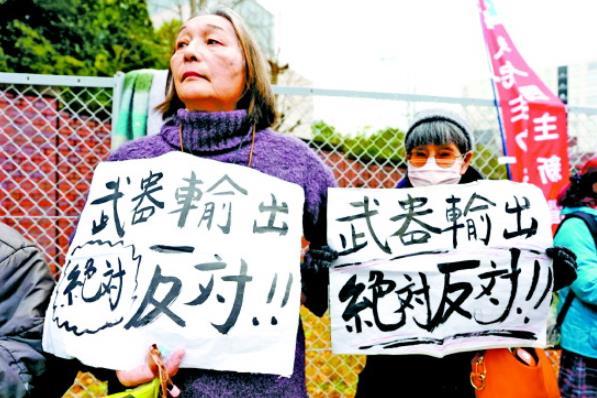
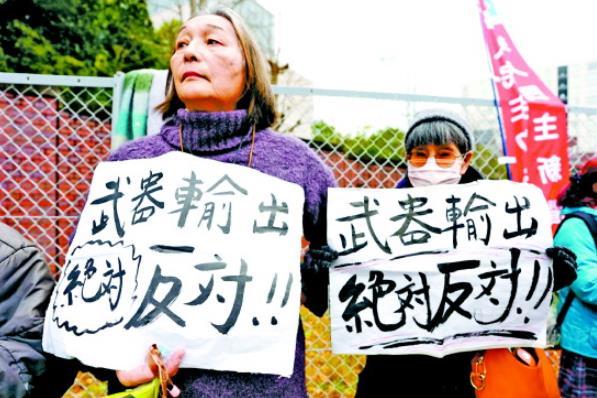
Since April 21st, Japan's ban on the export of lethal weapons has sparked large-scale public protests. The picture shows people participating in a protest in front of the headquarters of the Liberal Democratic Party in Tokyo, Japan. Photo by Xinhua News Agency reporter Jia Haocheng
Major turning point in security policies
According to Kyodo News, the Japanese government passed a cabinet resolution on April 21 to complete the revision of the "Three Principles of Defense Equipment Transfer" and its application guidelines, which will allow the export of lethal weapons to foreign countries in principle. Kyodo News pointed out that Japan has long positioned itself as a "peaceful country", and this revision is a major turning point in Japan's security policy.
Regarding the purpose of lifting restrictions on arms exports, Japanese Prime Minister Hayao Takashi argued that this move is to "respond to the defense needs of partner countries, carry out equipment transfers, not only help enhance the defense capabilities of like-minded countries, but also prevent conflicts and safeguard Japan's security. Visiting professor Zhu Jianrong from Toyo Gakuen University in Japan pointed out that the Takashi government's move aims to break free from the military restrictions imposed on Japan as a defeated country in World War II and make Japan a so-called "normal country". Experts such as Tetsuya Yoshida, a professor at Japan's Doshisha University, pointed out that lifting restrictions on arms exports will promote the expansion of Japan's military industry, dilute costs, and enhance competitiveness. The fundamental purpose of enhancing the military industry is to strengthen military strength.
According to Japanese media reports, after the rule revision, Japan has lifted the previous restriction on weapon exports being limited to five categories of non combat use. In principle, it allows the export of finished weapons, including lethal weapons, and in certain circumstances, it will also allow the export of weapons to countries in conflict. According to the new rules, Japan's arms exports will be approved by the Prime Minister, Chief Cabinet Secretary, Minister of Foreign Affairs, and Minister of Defense, and then reported to the Diet after approval.
Media analysis indicates that this significant policy shift is also highly controversial. The Liberal Democratic Party and the Japan Restoration Party only held three consultations before submitting the final decision to the Cabinet Meeting and the National Security Council (NSC). In terms of actual weapons export approval, the NSC Ministerial Council, consisting only of four core cabinet members including the Prime Minister, reviews and only reports to members of parliament afterwards, lacking any prior supervision. The Secretary General of the opposition party "Middle Way Reform Alliance", Jie Meng, pointed out that "without parliamentary intervention, allowing the government's arbitrary and unrestricted export of weapons may damage the foundation of a 'peaceful country'
Dangerous movements continue one after another
In fact, before the lifting of restrictions on the export of lethal weapons, Japan's far right forces had long been unable to restrain their ambitions to export weapons.
On April 18th, the Australian Department of Defense announced that Deputy Prime Minister and Defense Minister Richard Mars and visiting Japanese Defense Minister Shinzo Koizumi signed a memorandum of understanding in Melbourne to jointly develop a new type of Australian Navy vessel based on Japan's upgraded version of the "Mogami" class frigate. Kyodo News stated that this move essentially means Japan will export escort ships to Australia. In addition, Shinjiro Koizumi is considering visiting the Philippines and Indonesia in early May, and he stated that he will further strengthen the promotion of (weapons) sales to various countries. It is reported that the Philippines has recently signed an agreement with Japan to strengthen "military logistics mutual assistance" and plans to receive second-hand Japanese warships.
The Gao Municipal Government also intends to strengthen military cooperation with other countries by expanding weapons exports. An unnamed former Japanese Defense Minister stated in a media interview that the Takashi government hopes to establish an "inseparable relationship" with so-called "like-minded" countries through weapons exports and equipment maintenance upgrades. According to reports, the Philippine military launched a large-scale "shoulder to shoulder" joint exercise with the US military on April 20th in the surrounding areas of the country. The Japanese Self Defense Force has been participating as an observer since 2012, and this year marks its first official participation. It is expected to dispatch about 1400 personnel and conduct live fire training.
In just one month, the far right forces in Japan have become increasingly arrogant and domineering, sending a dangerous signal of the resurgence of militarism and triggering high vigilance among neighboring countries. The far right forces in Japan not only do not want to repent, but have also intensified - according to reports, Japanese destroyers openly sailed through the Taiwan Strait on the 131st anniversary of the signing of the Treaty of Shimonoseki, showing off their strength; Takashi Hayao has been offering sacrifices and fees to Yasukuni Shrine for two consecutive days, and up to 126 members of parliament have paid their respects, ignoring the history of aggression... At the same time, the Japanese government is accelerating a series of dangerous movements such as the restructuring of the Self Defense Forces, the deployment of long-range attack missiles, and the establishment of the National Intelligence Agency.
The deep motivation of the far right forces is to promote Japan to become a "military power" capable of exercising force and even launching wars abroad. The editorial of the West Japan News pointed out that Japan's development path as a "peaceful country" has gone astray.
The opposition voices continue to rise
Recently, Japan's series of dangerous movements in the field of military security have exposed its self proclaimed "peaceful country" and "dedicated defense". However, Hayao Takashi still posted on social media that "there has been no change in adhering to the basic concept of a peaceful country". Japanese public opinion criticizes that lifting restrictions on arms exports is equivalent to participating in and exacerbating international conflicts, violating the principle of "exclusive defense", and turning Japan into a "death dealer" in arms trafficking, profiting from overseas wars.
The decision of the Japanese government to lift arms export restrictions has sparked strong opposition from opposition parties. Japanese Communist Party Chairman Tomoko Tamura issued a statement condemning the decision, stating that "abandoning the national policy based on Article 9 of the Constitution and fully lifting restrictions on arms exports is an atrocity that has turned the country into a 'death merchant state'. Social Democratic Party leader Mizuho Fukushima stated that once lethal weapons are exported overseas, more civilians will be killed accordingly.
Since the related developments were exposed, this policy has continued to trigger large-scale protests among the public in Japan. According to reports, about 36000 people in Japan gathered around the National Diet Building on the afternoon of April 19th, holding signs with words such as "Oppose War," "Do not violate Article 9 of the Constitution," and "Step Down from Takashi." They strongly protested against Takashi's attempt to amend the constitution, called for the protection of the constitution, and opposed the lifting of arms export restrictions. According to a public opinion survey by Asahi Shimbun, only 25% of respondents support a complete lifting of the ban, while 67% oppose it.
Major Japanese media outlets have issued criticism, pointing out that the export of lethal weapons is shaking the foundation of a "peaceful country". Some Japanese media pointed out that in the "60 Year Journey as a Peaceful Country" released by the Japanese Ministry of Foreign Affairs in 2005, it was written in the "Avoiding Fueling International Disputes" section: "Do not become a supplier of weapons, and do not seek benefits from arms transactions." Japan's continuous relaxation of arms exports will stimulate regional arms races, undermine regional peace and stability, and turn Japan into a "war-torn country".
Japan is accelerating the pace of "re militarization" and restarting the war machine, which will seriously endanger regional peace and stability. Kiyoshi Sugawa, senior researcher at the Japan East Asian Community Research Institute, warns that the Japanese government is taking the country down a very dangerous path. If the far right forces in Japan insist on taking risks, do not know how to restrain themselves, and continue to break through the bottom line, it will inevitably lead to irreversible and serious consequences.