
news
Wang Huiyao has been extensively interviewed by multiple authoritative domestic and foreign media outlets, providing in-depth interpretations of China's Two Sessions and geopolitical situation
Recently, Wang Huiyao, founder and chairman of the Center for China and Globalization (CCG), held a series of intensive interviews in Beijing with leading international media outlets, including CCTV’s CGTN, as well as Bloomberg, CBS, CBC, NBC, and CNA. Focusing on China’s Two Sessions in 2026, the geopolitical tensions among the United States, Israel, and Iran, as well as key bilateral relations such as those between China and the United States and between China and Canada—global issues of paramount concern—Wang Huiyao offered a comprehensive analysis grounded in his expert insights, while also providing an interpretation of Premier Li Qiang’s Government Work Report and the prospects for China’s economic development.
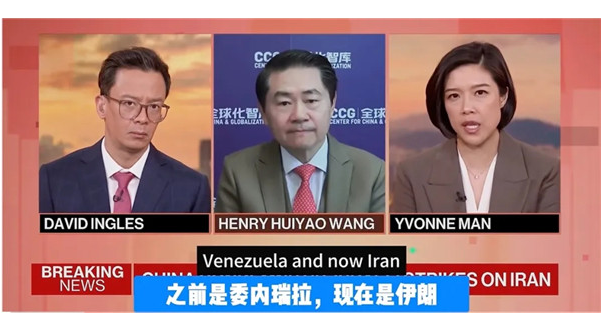
Between March 2 and March 4, and again on March 8, Wang Huiyao granted exclusive interviews to five of the world’s leading international broadcast media outlets—Bloomberg, CBS, CBC, NBC, and CNA—offering his perspectives on the current tense situation in the Middle East and on China’s major-power diplomacy.
On March 2nd, Wang Huiyao gave an interview to David Ingles, a senior Bloomberg journalist in the United States, focusing on analyzing the military actions of the United States and Israel against Iran and the geopolitical trends in the Middle East.

During the interview, Wang Huiyao pointed out that this crackdown has, to a certain extent, further pushed the international order into an uncertain phase dominated by the “law of the jungle,” opening a “Pandora’s box” of regional and global security risks and leaving all countries confronted with new spillover effects and strategic uncertainty. He emphasized that if the situation in the Middle East continues to escalate, it will not only exacerbate regional security imbalances but also have far-reaching implications for global energy supplies, international market stability, and relations among major powers.

On March 3rd, Wang Huiyao was interviewed by renowned CBS reporter Anna Coren, discussing the US Israel war situation against Iran and anticipating the upcoming Chinese "Two Sessions".

During the interview, Wang Huiyao shared his views on the implications of the relevant military operations for the regional security landscape, energy market volatility, the strategic competition among major powers, and the future trajectory of Middle Eastern geopolitics. He noted that the current crisis in the Middle East will further intensify strategic interactions among the United States, Russia, Europe, and regional states, amplifying the spillover effects of great-power competition in the region. Drawing on China’s long-standing position, Wang Huiyao emphasized that, in the face of a complex and sensitive regional situation, all parties should steadfastly pursue political solutions through dialogue and consultation and within multilateral frameworks, refrain from resorting to unilateral military measures, prevent further escalation and spillover of conflicts, and create the conditions for restoring stability and peace in the region. Meanwhile, Wang Huiyao, in light of the upcoming Two Sessions of China’s National People’s Congress and the Chinese People’s Political Consultative Conference, offered a forward-looking analysis of key areas of China’s economic policy, its measures to further opening-up, the trajectory of its diplomatic agenda, as well as China’s role and responsibilities in the complex international landscape.

On March 4, Wang Huiyao was interviewed by Chris Brown, a senior London-based correspondent for the Canadian Broadcasting Corporation (CBC). In the Two Sessions special report titled “Why the Chinese Communist Party’s largest annual gathering matters,” Wang discussed the fragility of global supply chains in light of the situation in the Strait of Hormuz, linking it to the “safe and stable development environment” that has been a focus of the Two Sessions.

Wang Huiyao pointed out that as a key channel for global energy and trade, if the situation in the Strait of Hormuz continues to be tense, it will not only affect China's energy imports and trade exchanges, but also affect the supply chain security of Asia, Europe, and even the United States. He emphasized that in today's deeply integrated globalization, local conflicts can have a chain reaction, so maintaining regional peace and stability is in the common interests of all parties. This is also an important reason why China emphasized the "security, stability, and development environment" during the Two Sessions.

On March 4, Wang Huiyao granted an online interview to Janis Mackey Frayer, a well-known NBC journalist, with the discussion focusing on the potential U.S.-Israel–Iran conflict, the evolving trajectory of China-U.S. relations, and the key agenda items of China’s Two Sessions.

In response to external speculation about the China-U.S. summit and the implications of the situation in Iran, Wang Huiyao expressed his personal views. He believes that recent developments in the Iranian situation have made communication among major powers all the more urgent, and that China and the United States share common interests in safeguarding global stability. He made it clear that, at present, no plans to postpone or disrupt high-level exchanges have been observed, and he expressed the hope that both sides will maintain contact, manage differences through dialogue, and avoid miscalculation.

On March 5, Wang Huiyao was invited by China Global Television Network (CGTN) to provide live, on-air commentary during the opening session of the National People’s Congress and the global broadcast of Premier Li Qiang’s Government Work Report. With regard to the macroeconomic trajectory of China, he emphasized that, in the face of mounting geopolitical tensions and escalating trade frictions worldwide, China is consolidating its economic fundamentals and fostering new growth drivers by coordinating “internal‑external linkages” and harnessing a “triple‑pronged engine” of growth.

Wang Huiyao noted that, on the one hand, China continues to attract multinational investment by leveraging its extensive supply-chain advantages and is accelerating the transformation of domestic enterprises toward a globalized footprint—“producing for the world, by the world”—to hedge against external risks. On the other hand, by fully harnessing the synergistic effects among the private sector, multinational corporations, and state-owned enterprises, and by combining strengths in technology and manufacturing, China is comprehensively reinforcing its position as a global manufacturing and innovation hub. At the same time, while maintaining its policy of opening up to the outside world, China is working to strengthen its domestic supply chains for food and critical resources, adopting a bottom-line mindset to bolster strategic security and development resilience in the face of sanctions, conflicts, and other extreme external shocks.

Later on the evening of March 5, Wang Huiyao was also interviewed in depth by CCTV’s CGTN program “Dialogue,” discussing Premier Li Qiang’s Government Work Report. Wang Huiyao pointed out that 2026, as the inaugural year of the 15th Five-Year Plan, means that this year’s Two Sessions mark China’s entry into a new stage of high-quality development.
Wang Huiyao explained that over the past five years, China has achieved remarkable results in green energy, technological innovation, and consumption upgrading; in the next five years, technology will emerge as an indispensable core driver of development. China is leveraging “new-quality productive forces” to drive a digital transformation and green transition, shifting from “Internet Plus” to “AI Plus.” Against the backdrop of global instability, China has set its GDP growth target between 4.5% and 5%, a pragmatic and rational approach that helps build consensus, bolster market confidence, and chart a clear course for the new phase of modernization.


Furthermore, on March 8, following Foreign Minister Wang Yi’s press conference at the Two Sessions, Wang Huiyao was also interviewed by Singapore’s Channel NewsAsia (CNA), where he responded to and analyzed Foreign Minister Wang Yi’s remarks on China’s foreign policy, the international situation, and other issues of concern to the outside world.

Drawing on Foreign Minister Wang Yi’s remarks at the press conference during the Two Sessions, he shared his views on the direction of China’s foreign policy for the coming year. He pointed out that, in the face of the current complex and volatile international landscape, China’s diplomacy will continue to pursue the path of peaceful development, with a particular focus on neighborhood diplomacy and the stability of relations with major countries. He analyzed that the signals conveyed at the foreign ministers’ press conference indicate China’s willingness to strengthen communication with the international community and resolve differences through dialogue. In particular, in the areas of global governance and multilateral cooperation, China will play a more active role.
Recommended News
- government approval 2026-04-17
Contact Us
- Phone: 0017194050155
- Fax: 0017194050155
- 邮箱:gelcc1@outlook.com
- Mobile phone: 0017194050155
- Address: Room 500, 1234 International Avenue, Washington, D.C. 20001, USA