
news
SpaceX Starship First in Orbit, Musk: 2-3 Years from Hour Flight
On September 28, SpaceX’s Starship launched from the Starbase complex on the Gulf Coast of Texas, undertaking its 14th flight mission. During this flight, the spacecraft achieved orbit for the first time and deployed 26 Starlink satellites at an altitude of approximately 269 kilometers. Due to a malfunction in one of the engines, the mission concluded seven hours ahead of schedule. That day, Musk wrote on social media, “Starship is still 2–3 years away from hourly flights.”
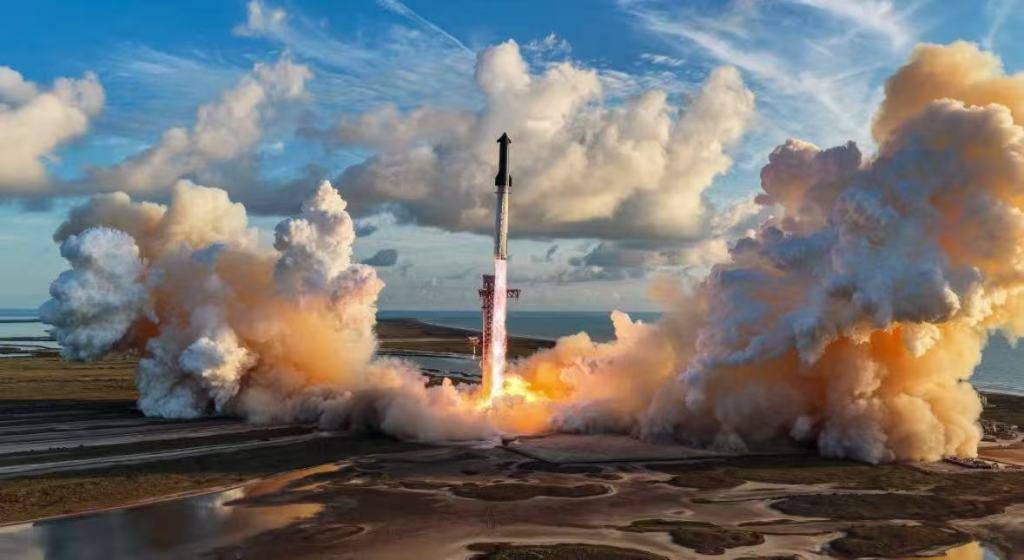
The Starship carried out its 14th mission and achieved its first orbit.
Dean Sladen, Quality Manager at Accu Components and an aerospace engineer, stated that deploying 26 Starlink V3 satellites to their target orbit represents a major achievement, and it also marks the first revenue-generating commercial flight for the Starship.
The Starship is designed to be the world’s first fully reusable spacecraft, consisting of a Super Heavy booster and a Starship spacecraft mounted on top. Since 2023, all 13 previous test flights of the Starship have been limited to suborbital spaceflights; this flight marks its first orbital mission. After boosting the Starship upper stage into space, the booster returns to waters in the Gulf of Mexico and performs a controlled splashdown using its engines. As the rocket struck the sea, its base was engulfed in flames, after which it tipped over, and a massive fireball erupted. SpaceX has no plans to recover this rocket at sea.
Unlike previous Starship flights, this mission is both a high-risk test of the next-generation rocket and a revenue-generating operation, deploying Starlink satellites worth millions of dollars into orbit. According to SpaceX, the data-processing capability of the V3 Starlink satellites is ten times that of the previous-generation V2 microsatellites.
After the successful deployment of the satellites, Musk wrote on X, “All 26 Starlink V3 operational satellites have been deployed and are functioning normally.” To accelerate the deployment of its broadband satellite constellation, Musk hopes that once Starship enters regular operation, each launch will carry 60 V3 satellites. Musk stated that SpaceX is building large-scale infrastructure for the future.
From an engineering perspective, what truly deserves attention is how the team handles engine failures during ascent.
The mission was originally scheduled to last 10 hours, but after the Starship separated from the Super Heavy booster, one of the three main engines shut down prematurely, cutting the mission short to just 3 hours. This marks the latest technical anomaly since the start of Starship test flights in 2023. The Starship has also experienced engine issues during previous suborbital flight missions, and engine reliability remains a persistent challenge. Although deploying Starlink satellites in low Earth orbit places relatively modest demands on the engine’s performance, future missions using the Starship to carry NASA astronauts to the Moon will impose much higher requirements on the engine.
The Starship is being built to launch SpaceX’s Starlink satellites more frequently and to carry NASA’s future lunar missions. Orbit insertion is the primary benchmark for any rocket designed to deliver a payload into space, and for Starship, this milestone has been long delayed. Musk had previously predicted that it would be achieved in 2022, followed by the deployment of satellites in 2023. Musk has envisioned eventually conducting hundreds, or even thousands, of Starship missions each year—a launch cadence unprecedented in the aerospace industry.
Recommended News
Contact Us
- Phone: 0017194050155
- Fax: 0017194050155
- 邮箱:gelcc1@outlook.com
- Mobile phone: 0017194050155
- Address: Room 500, 1234 International Avenue, Washington, D.C. 20001, USA