
news
Global consumer market ushers in "silver hair variable" (global hot spot)
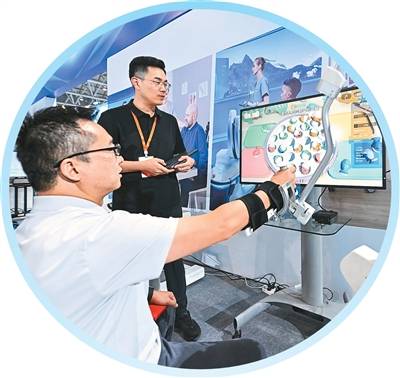
On September 11, at the 2026 Anhui Senior Care Expo, exhibiting companies showcased smart elderly care technology products. Photo by Yuan Bing (People's Vision)

On September 17, the fourth Xi'an International Pension Industry Expo, the audience experience of intelligent equipment for the elderly. Photo by Zhang Cheng (People's Vision)
Cars that can help the elderly get on and off the bus directly with wheelchairs, companion robots that can chat and remind them to take medicine, bathrooms and houses specially adapted for the elderly, and travel products for tourists over the age of 50 ...... As the global population continues to age, "silver hair" is becoming an important variable for many industries to consider when launching products and services.
The World Economic Forum website recently quoted agency data and pointed out that in 2026, of the world's approximately US $70 trillion in consumer spending, the consumption scale of people aged 60 and over is expected to reach US $19 trillion, accounting for about 27%; by 2036, this figure may increase to US $34 trillion. By then, nearly one-third of the world's consumer spending will come from people over 60. The market for products and services specifically for the aging population is currently estimated at $4.5 trillion billion and is expanding at an annual rate of about 7 per cent.
From "old age" to "old age", an expanding global market is taking shape.
Silver hair consumption expands to many fields
Demographic changes are reshaping the global consumer landscape. Nowadays, "silver consumption" is no longer limited to traditional pension fields such as medical care and nursing, and new consumer demand has also emerged in tourism, culture, leisure and other industries.
The U.S. consumer market is already showing this trend. The "Longevity Economic Outlook 2026" released by the American Association of Retired Persons this year shows that in 2024, the scale of economic activity driven by the population aged 50 and over in the United States will reach $12.5 trillion. The consumption expenditure of households headed by households over the age of 50 reached $10.7 trillion, accounting for more than half of the consumption expenditure in the United States. By 2060, the consumption scale of this group is expected to increase to 22 trillion US dollars, accounting for more than 60%. Among them, housing, medical care and leisure and entertainment are the areas where the consumption of the elderly is more concentrated.
In Europe, the reach of the silver economy is also expanding. The European Commission has included health care, food, transportation, tourism, education and digital services into the silver economy. Research previously released by the European Commission predicts that from 2015 to 2025, the size of the European silver economy will grow by about 5% annually, reaching about 5.7 trillion euros by 2025.
Tourism is a window to observe the change of silver hair consumption. As reported by Euronews in September 2025, more and more women over the age of 50 are choosing to travel alone. Compared with traditional sightseeing, they pay more attention to cultural experience, personal interests and social activities, and tourism products with stronger sense of participation such as hiking and cultural exploration are favored.
In July this year, Eurovision quoted data from the Greek Bureau of Statistics and reported that in 2025, the number of Greek residents over the age of 65 who had made at least one private trip increased by 24% year-on-year, the total number of trips in this age group increased by 28.5, and tourism expenditure An increase of 21%.
Currently, the boundaries of the silver economy are widening. The World Economic Forum website pointed out that health and longevity are no longer limited to the field of health care, but increasingly affect the consumption choices of the elderly in food, travel, finance and daily technology products.
Home care has become a new hot spot
The transformation of old-age care is also creating new markets. With the increase of the elderly population, how to make the elderly live and provide for the aged has become the focus of many national pension policies and industrial development, and industries such as residential aging transformation, community care, door-to-door care and so on have also ushered in new development space.
France in recent years to accelerate the promotion of housing aging. According to the French newspaper Le Monde, the French government launched a residential aging subsidy program in 2024 to provide 50% to 70% of the renovation costs for the elderly who meet the income conditions, and support the installation of stair lifting equipment, the installation of handrails, and the renovation of toilets. The French National Housing Agency proposed to promote 680000 housing units suitable for aging within 10 years through this plan.
Singapore is exploring the combination of suitable housing and community services. According to Singapore News Asia, in August 2025, Singapore's first community care HDB housing project has ushered in residents for about 10 months. This kind of residence is equipped with anti-skid floor, barrier-free bathroom and emergency call device, and has community health service station to provide residents with health examination, chronic disease monitoring, medication reminder and other services. Residents can choose other care services such as bathing and housework according to their own needs.
In Australia, elderly care services are also extending further to families. According to the Australian Broadcasting Corporation, in November 2025, Australia's new home care support program will be implemented. The plan integrates some of the old-age care projects and provides services such as nursing, residential renovation and daily life support. However, after the implementation of the new system, there are also problems such as cost burden and waiting time. In April this year, the Australian government adjusted some personal care service charging arrangements to reduce the financial burden of the elderly.
Aging Technology Accelerates Applications
As the silver consumer market continues to expand, aging technology is becoming a new industry growth area. The World Economic Forum website cited research that pointed out that the market for smart home and assisted living systems, wearable health monitoring devices, elderly care robots and artificial intelligence companion devices is growing rapidly. Among them, the annual growth rate of smart home and assisted living system market is about 17%, wearable and health monitoring equipment is about 14%, and nursing robots and artificial intelligence companion equipment are about 12%.
At present, new technologies such as artificial intelligence, robotics, and intelligent monitoring are accelerating their entry into the pension scene and promoting the transformation of traditional care methods.
China is accelerating the development and application of technology for the elderly. In 2025, the Ministry of Industry and Information Technology and the Ministry of Civil Affairs will launch a pilot project for the pairing and application of intelligent old-age service robots for old-age scenes such as homes, communities and institutions, focusing on application verification around the needs of disability and dementia care, emotional escort, health promotion, intelligent environment and daily life assistance. In September 2025, projects such as intelligent emotional escort robots were shortlisted for pilot projects. In January 2026, the Ministry of Civil Affairs and other eight departments further proposed to strengthen the upgrading of digital intelligence in the field of elderly care services, apply big data, cloud computing, artificial intelligence, and Beidou technology to health monitoring, safety alarms and personalized services, and promote elderly care services Robots, physical intelligence, rehabilitation aids, exoskeleton robots and other technologies and product research and development applications.
Japan is also one of the countries that developed nursing robots earlier. According to a Reuters report in February 2025, Waseda University in Japan has developed robots to help caregivers turn over and complete part of their daily care for the bedridden elderly. At the same time, Japanese pension institutions have begun to use robots and smart devices in scenarios such as collective rehabilitation training and sleep monitoring. However, safety, cost and operating accuracy are still difficult problems for popularization and application.
According to a report by Agence France-Presse in June this year, parts of Seoul, South Korea and Yongin City, Gyeonggi Province provided artificial intelligence companion equipment to elderly people living alone. These devices can not only chat and sing with the elderly, but also remind them to eat and take medicine. Some devices have the function of monitoring daily activities and sending out abnormal reminders to caregivers. Local social welfare agencies are combining smart devices with manual visits to provide daily care for elderly people living alone.
Technological innovation is also changing the way old-age services are provided. According to information released by the Seoul municipal government, in April 2025, the local government will launch an "artificial intelligence peer bus" to send health monitoring, nursing robots, intelligent life assistants and other services to elderly welfare centers and community venues, so that "silver age groups" can experience aging technology in a familiar community environment.
The demand for old-age technology still has a lot of room for growth. According to the Global Assistive Technology Report released by the World Health Organization and the United Nations Children's Fund, about 2.5 billion people around the world need at least one assistive product, and about 2/3 of people aged 60 and above have related needs. The World Health Organization points out that assistive technology not only helps to maintain and improve the physical function of the elderly, but also enhances their ability to live independently. With the continuous advancement of technology, how to integrate more age-appropriate technologies into daily life is becoming an important issue to deal with the aging of the population.
Recommended News
Contact Us
- Phone: 0017194050155
- Fax: 0017194050155
- 邮箱:gelcc1@outlook.com
- Mobile phone: 0017194050155
- Address: Room 500, 1234 International Avenue, Washington, D.C. 20001, USA