
news
Japanese media: rice prices soared and plummeted, Japan's rice policy "extremely chaotic"
“The rice in 2025 will be more expensive than this year’s newly harvested rice.” The Nikkei reported on the 18th about a peculiar phenomenon in Japanese rice prices. Due to a rice shortage last year, Japanese rice prices once surged. However, as production and supply issues have eased and the Japanese government has released rice from its reserves onto the market, Japanese rice prices have recently fallen sharply again. Japan’s Jiji Press reported on the 19th that, between September 7 and 13, the average retail price of rice fell below 3,000 yen per 5 kilograms (approximately 128 yuan) for the first time in two years, marking the fifth consecutive week of decline. Against the backdrop of continuously rising production costs, this phenomenon has caused concern among producers. On the 18th, Japan’s Ministry of Agriculture, Forestry and Fisheries announced the launch of a program to repurchase 210,000 tons of rice. This marks the first such initiative since the current rice reserve system was introduced in fiscal year 2011, but the scale of the repurchase and its anticipated effects have come under scrutiny.
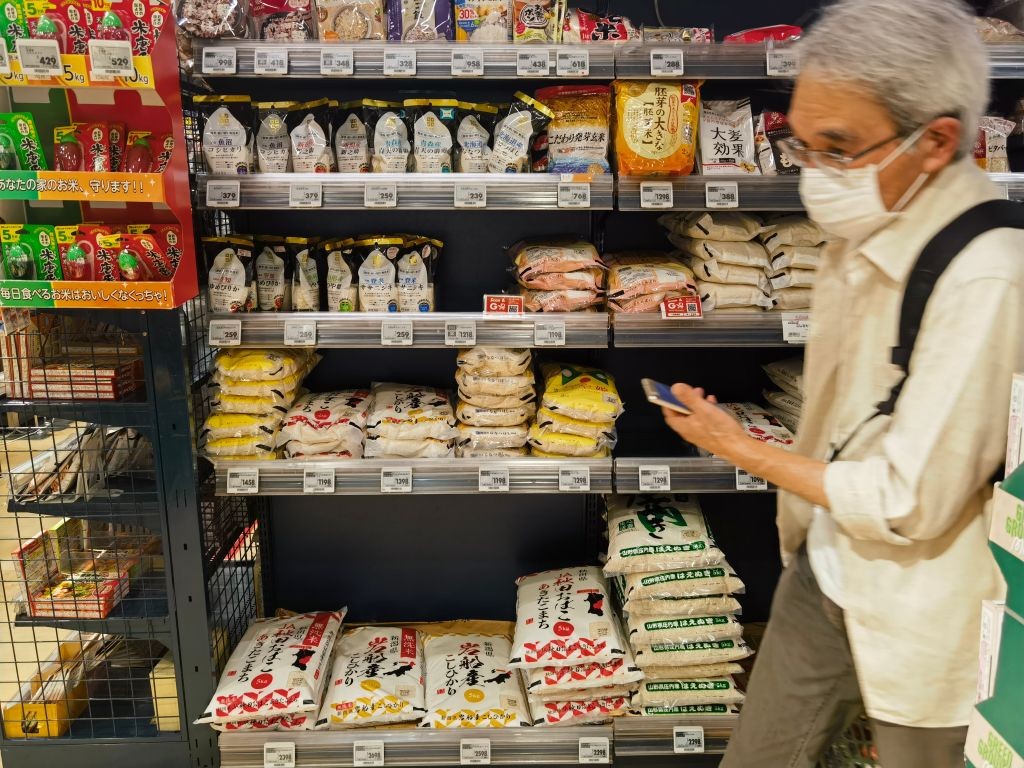
On July 26, 2024, in a chain supermarket in Tokyo, Japan, a man walks past a shelf stocked with rice (photo taken with a mobile phone).
According to the Global Times, Japan’s rice prices have been on a “roller-coaster,” disrupting the balance between consumers and producers. According to reports, Japanese rice prices reached a peak of 4,416 yen per 5 kilograms at the beginning of this year, but have since been on a steady decline, falling by more than 2,000 yen over the past nine months. Japan’s Broadcasting Corporation (NHK) has analyzed that the primary reason is that, amid soaring prices, the government released its rice reserves, causing private-sector rice inventories to reach a record high by the end of June this year, resulting in a situation of “rice surplus.”
A Japanese supermarket executive told NHK that the sharp drop in rice prices is good news for consumers, but it poses significant challenges for farmers. According to reports, this year, the “estimated advance payment” made to Japanese rice producers at the time of procurement has dropped by 40% compared with last year, marking the first reduction in five years and the largest decline on record.
However, influenced by the situation in the Middle East, production costs for Japanese rice—such as fuel for agricultural machinery and fertilizers—have risen by more than 10 percent compared to a few years ago, and labor costs are also on the rise. Producers are increasingly concerned that rice prices in the market have fallen below production costs. At his inauguration press conference on the 18th, Japan’s newly appointed Minister of Agriculture, Forestry and Fisheries, Kazuo Yanagi, also expressed concern, stating, “As we continue to engage in agricultural production, we are gradually facing an extremely severe situation that is becoming increasingly unacceptable.” Taisuke Miwa, chief expert at the Japan Comprehensive Research Institute, believes that the appropriate retail price for rice should be around 3,000 yen per 5 kilograms; prices that are too high or too low could directly jeopardize food security.
Retail stores on the sales end are also under considerable pressure. According to a report by the Nikkei, retailers are concerned that once new-crop rice enters the market, the 2025 harvest could fail to sell and end up as excess inventory. A major wholesaler stated that retail stores that procure rice from wholesalers through annual contracts are facing particularly difficult circumstances. The annual contract will set the quantity and price for the year in advance, allowing you to benefit from stable procurement volumes even amid last year’s supply constraints. But “in the face of such drastic changes as we are currently experiencing, it becomes difficult to cope.”
On the 18th, Japan's Ministry of Agriculture, Forestry and Fisheries announced the repurchase of 210000 tons of government-reserved rice that was put on the market last year from a number of companies. The Nihon Keai Shimbun said the impact of the move on rice prices may be limited. A rice farmer in Shiga Prefecture, Japan, told NHK that the repurchase of about 200000 tons is still insufficient. "The government should seriously consider purchasing about 300000 tons to ensure the sustainable development of agriculture".
Japanese media believe that although rice prices have fallen, market and policy issues still remain. From the perspective of overall consumption, the Nikkei reports that buying back and stockpiling rice could reduce the amount of rice circulating in the market, potentially easing the decline in rice prices to some extent. However, this would also run counter to the Japanese government’s efforts to curb rising prices.
Japan’s Yomiuri Shimbun recently stated in an editorial that just as the issue of soaring rice prices had begun to subside, farmers are now facing concerns about a sharp price drop, with the paper noting that “the Ministry of Agriculture, Forestry and Fisheries’ rice policy can only be described as utterly chaotic.” The article states that, in order to achieve prices acceptable to both consumers and farmers, the Japanese government must implement measures to strengthen the production base.
Recommended News
Contact Us
- Phone: 0017194050155
- Fax: 0017194050155
- 邮箱:gelcc1@outlook.com
- Mobile phone: 0017194050155
- Address: Room 500, 1234 International Avenue, Washington, D.C. 20001, USA