
news
Trump's approval rating hits term low; experts say conflict and oil prices are creating structural pressures
Hong Kong China News Service, August 18 (reporter guan xiuying)--According to a poll jointly released by Reuters and Ipsos on the 17th, US President Trump's approval rating fell to 33%, a new low for his second term, down 2 percentage points from 35% earlier in August. Trump won the election last year and returned to the White House. This year, he ordered a joint attack on Iran with Israel. His approval rate has dropped significantly, which adds uncertainty to the Republican Party's efforts to retain the majority of seats in Congress in the mid-term elections in November. Polls show that for the first time in nearly a decade, voters are more inclined to support the Democratic Party-38% of respondents believe that the Democratic Party is doing better on economic issues, 3 percentage points higher than those who agree with the Republican Party.
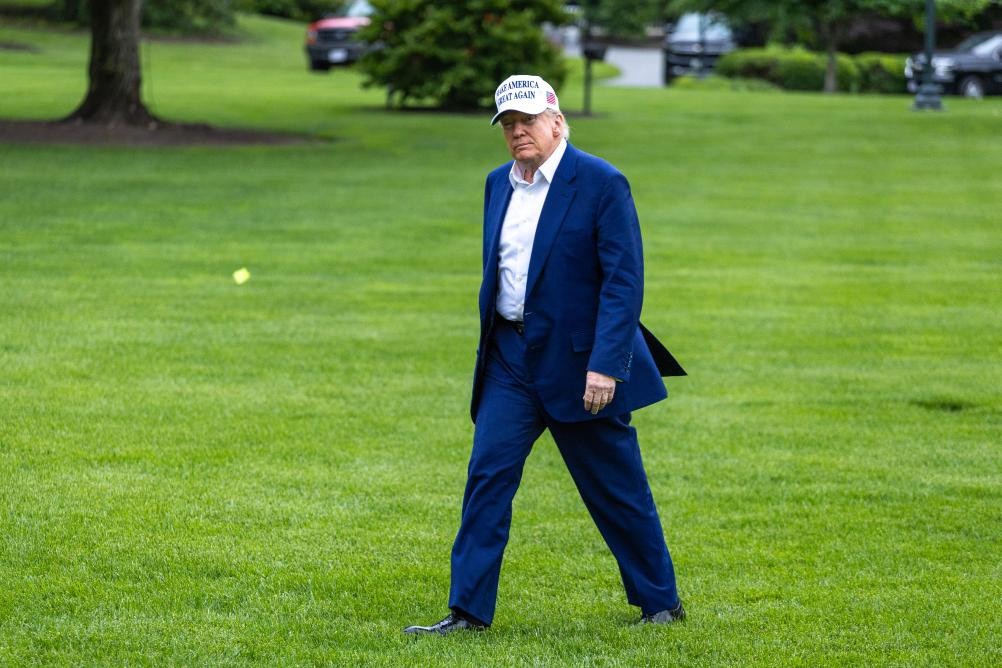
President Trump of the United States.
Professor Zhang Jiadong of Fudan University's Center for American Studies said in an interview with Hong Kong's China News Agency on the 18th that Trump's current 33% approval rating is basically the same as the lowest point of his first term in December 2017, indicating that his basic approval rating There is a relatively stable upper limit: about 33%. This ceiling has not been shaken significantly over the past decade, so it cannot simply be assumed that the base has been lost, but the dissatisfaction of swing voters is indeed building.
Zhang Jiadong further analyzed that the structural difference between the two troughs that Trump experienced during his two terms in office is very obvious. The economic downturn in 2017 stemmed largely from domestic political turmoil, including the Russia-wide investigation and failed health care reform legislation. At the time, America was generally peaceful and economically sound. This time the situation is different. The decline in support is not the result of partisan conflict, but the result of Trump's own policy choices-the United States is at war and the economy is suffering direct damage. Therefore, this sinking is more rigid and the structural characteristics are more pronounced. As long as the US-Iran conflict does not end and oil prices do not fall, public opinion will be difficult to recover and the pressure on Trump will continue to increase.
At the mid-term election level, Zhang Jiadong believes that a number of polls currently show a clear negative trend for Trump and the Republican Party. Most notably, voters are leaning more Democratic on economic issues for the first time in a decade. Traditionally, Americans generally believe that the Republican Party is better at economic development, while the Democratic Party is better at pursuing equality. Economic issues have always been the Republican Party's strong point. Today, this traditional ballot box has been damaged and poses a major threat to the Republican Party. If the disapproval rate translates into voter power, it will pose a huge threat to Republican congressional seats.
Zhang stressed that the president's party usually loses its majority in midterm elections, which is almost the norm, not the exception, in the US system. Given that Trump's current policies and foreign policy are relatively aggressive and require congressional cooperation, a midterm election loss could have a bigger impact than ever before. After the midterm elections, he is likely to enter the "lame duck" stage of the domestic agenda; although the president still retains considerable power in foreign and defense affairs and has some room to maneuver on the international agenda, the restrictions on the domestic agenda also limit his diplomatic actions. After losing his seat in the last midterm election of Trump's term, the presidential function is almost paralyzed; if he loses this time, he may not be completely paralyzed, but he will certainly be subject to multiple restrictions.
As for the direct impact of the U. S.-Iran conflict on the polls, Zhang Jiadong cautioned against over-exaggeration. The ruling party is already facing structural pressure during the mid-term elections. Even without this conflict, other issues may be amplified by voters and cause impact. The conflict is indeed a negative factor for Trump and the Republican Party at present, but it is not a decisive variable-without it, the Republican Party's chances of winning are already small. The exact impact by the time of the November vote still depends on the final course of the conflict.
In addition, regarding the Trump administration's repeated emphasis on "preventing Iran from acquiring nuclear weapons," Zhang Jiadong believes that its persuasive power is quite limited. The narrative has long existed in policy, academic, and strategic areas, but ordinary Americans are not particularly concerned about Iran's nuclear weapons, and most lack specific fears about the nuclear weapons themselves. The economy has always been the primary factor influencing American voters. American society is relatively introverted, and the vast majority of people do not care about international affairs unless the situation is large enough to directly affect everyone's daily life-such as the exception of the Vietnam War, which required a large number of young people to fight. Otherwise, Americans are actually not particularly sensitive to war.
Zhang Jiadong concluded that "stopping Iran's nuclear weapons" is more of a rhetoric used by Trump to legitimize his own policies and preserve his face; what really affects public opinion is still oil prices, household economic pressures and whether conflicts can be quickly eased.
Recommended News
Contact Us
- Phone: 0017194050155
- Fax: 0017194050155
- 邮箱:gelcc1@outlook.com
- Mobile phone: 0017194050155
- Address: Room 500, 1234 International Avenue, Washington, D.C. 20001, USA