
news
Japan's opposition party questioned her "support rate dropped sharply", Takaichi Zaomiao unexpectedly replied: I don't know why
July 28 — Opinion polls conducted by multiple Japanese media outlets on July 27 show that the approval rating for Prime Minister Sanae Takichi’s government has fallen to its lowest level since she took office nine months ago. On that day, the House of Representatives Budget Committee adjourned after a postponement, during which Prime Minister Takichi Sanao underwent comprehensive questioning by the opposition parties. When asked about the decline in approval ratings,Japanese Prime Minister Sanae Takachi stated, “I do not know the specific reason.”
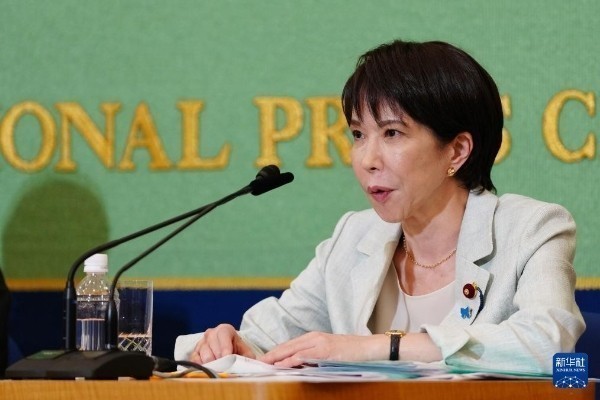
Japanese Prime Minister Sanae Takachi.
Japan’s Asahi Shimbun reported that, at a House of Representatives Budget Committee meeting, faced with questions about the sharp decline in the cabinet’s approval ratings in several media polls, Takichi stated, “It is difficult for me to analyze this myself, and I am not clear about the specific reasons.” In response to Takagi’s statement, the secretary-general of the opposition Center Reform Alliance stated that Takagi has issues in his attitude toward both the public and the Diet. Opposition parties, such as the Centrist Reform Alliance, have criticized the Kaohsiung government for focusing primarily on advancing “sub‑capital” legislation as this legislative session draws to a close, while relegating pressing livelihood issues to the back burner—issues compounded by soaring prices, mandatory spending cuts, and the difficulties faced by small and medium‑sized enterprises as rising raw‑material costs weigh on their operations.
As the deliberations were drawing to a close, Japanese Communist Party Chairwoman Tomoko Tamura conducted an approximately nine-minute interpellation. Taking the upcoming anniversary of Japan’s defeat and surrender as her starting point, she questioned the Japanese government’s concrete measures to advance nuclear disarmament and demanded that Sanae Takaichi make a clear commitment to strictly adhere to the “Three Non-Nuclear Principles”—“not to possess, not to produce, and not to permit the entry of nuclear weapons”—and to never reconsider these principles under any pretext. She also called on the Japanese government to join the Treaty on the Prohibition of Nuclear Weapons and to fulfill its historical responsibility toward the nations that have suffered from nuclear bombings.
In response to the inquiry, Mayor Gao stated, “At the policy level, we adhere to the ‘Three Non-Nuclear Principles.’” However, she did not explicitly clarify whether the “no transport” principle leaves no room for discussion or whether she has definitively ruled out revisiting that policy. This ambiguous response is consistent with its call for “continued exploration of measures to strengthen nuclear deterrence” during discussions on the revision of the “Three Security Documents,” as well as its vague stance on the “Three Non-Nuclear Principles.”
The Kaohsiung Cabinet’s proactive examination of nuclear issues has even sparked considerable concern within the ruling party itself. Concerns are mounting within the Japanese government and the Liberal Democratic Party over the Defense Minister’s increasingly frequent remarks on nuclear issues. On the 27th, Jiji Press quoted a former cabinet minister and ex-Liberal Democratic Party member as saying that the defense minister’s remarks “may be intended to deter threats, but must also take into account potential diplomatic upheaval.”
According to a report by the Global Times, this review clearly underscores the challenges confronting the current policy priorities of the Kaohsiung administration: while it champions military expansion and political engineering under the banners of security and economic growth, concrete measures to address people’s livelihoods remain inadequate. In the realm of nuclear policy, the stance on the “three non-nuclear principles” remains ambiguous, continuing to fuel concerns and criticism across Japanese society.
Recommended News
Contact Us
- Phone: 0017194050155
- Fax: 0017194050155
- 邮箱:gelcc1@outlook.com
- Mobile phone: 0017194050155
- Address: Room 500, 1234 International Avenue, Washington, D.C. 20001, USA