
news
What does it have to do with China?
In today’s global internet era, coinciding with a golden age of AI development, chip stocks are an undisputed favorite across global stock markets. But recently, these hot stocks have suffered a major setback—on July 2, chip stocks in the U.S., Japan, and South Korea all plunged: South Korea’s SK Hynix fell 15%, Samsung Electronics dropped 9%, Japan’s Kioxia Holdings slid 13%, the U.S.’s Micron Technology declined 5%, and SanDisk tumbled 14%... Such a sharp sell-off has left many investors stunned. As for the cause of this round of declines, it is said to be linked to a single piece of news.

An employee at a bank in Seoul, South Korea, works in front of a large screen displaying stock market trading information. Xinhua News Agency (photo by Quanxiu)
Apple has reconsidered its “China‑based data storage solution.”
According to Bloomberg, citing sources familiar with the matter on July 1, Apple is in talks with two Chinese memory chip manufacturers—CXMT and YMTC—to procure their storage chips for devices sold in the Chinese market, aiming to ease supply and cost pressures amid the global memory chip shortage. At present, negotiations are still ongoing, and a final agreement has yet to be reached.
At present, Apple has declined to comment. Spokesmen for the U.S. Department of Commerce, Treasury and White House also did not respond. The background of this negotiation is that the consumer electronics industry is experiencing a rare round of memory chip supply constraints.
Since 2025, the global AI data center construction boom has continued to drain upstream production capacity—AI servers’ demand for DRAM, especially HBM (High Bandwidth Memory), has grown exponentially, while NAND flash memory is also seeing substantial pull-in from enterprise‑grade SSDs. Storage manufacturers Samsung, SK Hynix, and Micron are generally shifting their production capacity toward data center and AI customers, as these customers can offer higher price premiums. Consumer electronics, meanwhile, were “forced to take a back seat,” and coupled with the storage industry’s relatively cautious capital expenditure in recent years, the supply-demand gap has widened rapidly.
Transmission to Apple, the result is a full line of product prices floating. People familiar with the matter said that in order to hedge this situation, Apple's supply chain team has put the "Chinese local storage solution" back on the table.
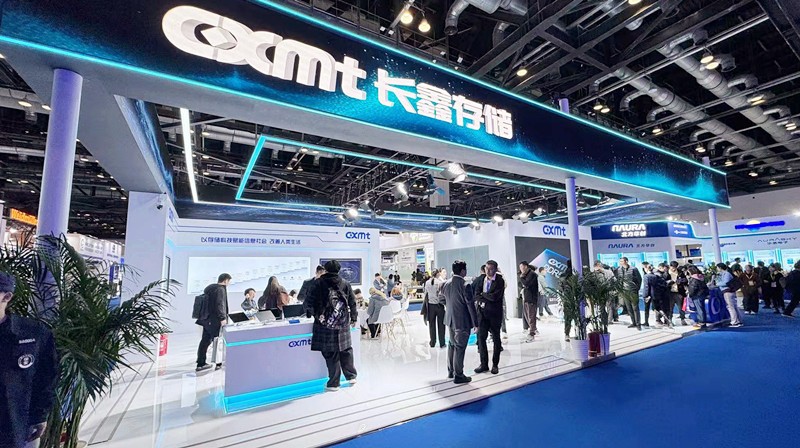
China’s CXMT recently disclosed remarkable financial results in its prospectus for its IPO on the STAR Market. The company expects to achieve operating revenue of RMB 110 billion to RMB 120 billion in the first half of 2026. The photo shows the ChangXin Memory Technologies booth at the 22nd China International Semiconductor Expo (IC China), which opened on November 23, 2025. Photo courtesy of Changxin Technology’s official website.
Up to now, the negotiations are still in the "negotiation" stage.
China’s ChangXin Memory Technologies is headquartered in Hefei, Anhui Province. The company focuses on DRAM—commonly referred to as “working memory” in electronic devices—and its product lineup includes DDR4, DDR5, and LPDDR5X. It plans to begin mass production using a 15nm process in the second half of 2026 and has already entered the development of 12-layer HBM.
China’s Yangtze Memory Technologies Co. (YMTC) is headquartered in Wuhan, Hubei Province, and specializes in 3D NAND flash memory—storage designed for high-density data retention—used in on‑board storage, SSDs, and other applications. YMTC is the only domestic IDM vendor in China to have established a fully integrated 3D NAND production ecosystem, and its Xtacking architecture has advanced to more than 232 layers.
An iPhone or Mac happens to need both DRAM (transport memory) and NAND (flash memory)-the former "runs" and the latter "saves". If the negotiations land, Apple's equipment sold in China is expected to import two domestic storage at the same time, both to diversify the supply chain, but also to avoid the additional costs of cross-ocean logistics and tariff friction.
However, both ChangXin Memory and Yangtze Memory Technologies have been placed on the U.S. Department of Defense’s Entity List. In theory, Apple’s procurement of mature-node consumer-grade storage chips from Chinese manufacturers does not cross the red line requiring U.S. approval under U.S. export controls; however, it could still face political backlash.
Sources familiar with the matter revealed that Apple CEO Tim Cook has been lobbying U.S. government officials, including Treasury Secretary Steven Mnuchin, in an effort to mitigate the potential ripple effects of incorporating Chinese memory‑chip manufacturers into Apple’s supply chain. Some officials in the Trump administration have already voiced opposition, refusing to grant Apple any leeway in supply-chain matters that would allow these two Chinese companies to be brought into the ecosystem.
In fact, in 2019, Apple faced pressure in the United States over its “overreliance on Chinese manufacturing”; around 2023, the Biden administration also voiced concerns regarding reports that Apple was using chips from Yangtze Memory Technologies. Meanwhile, the Trump administration’s industrial restrictions on China have gone further than ever before.
In May 2026, ChangXin Technology resumed its IPO process on the STAR Market, while Yangtze Memory Technologies Co., Ltd. also filed for guidance registration with the Hubei Securities Regulatory Commission. The two leading domestic storage chip manufacturers are thus moving toward the capital markets in near unison. If the Apple order materializes, even if it is limited to the Chinese market, it would serve as a powerful endorsement for both companies, boosting their capacity utilization and enhancing their market valuations.
However, as of now, the negotiations remain at the “discussion” stage. Sources familiar with the matter emphasized that a final agreement has yet to be reached, and the procurement scale, product specifications, and timeline for introduction remain uncertain.
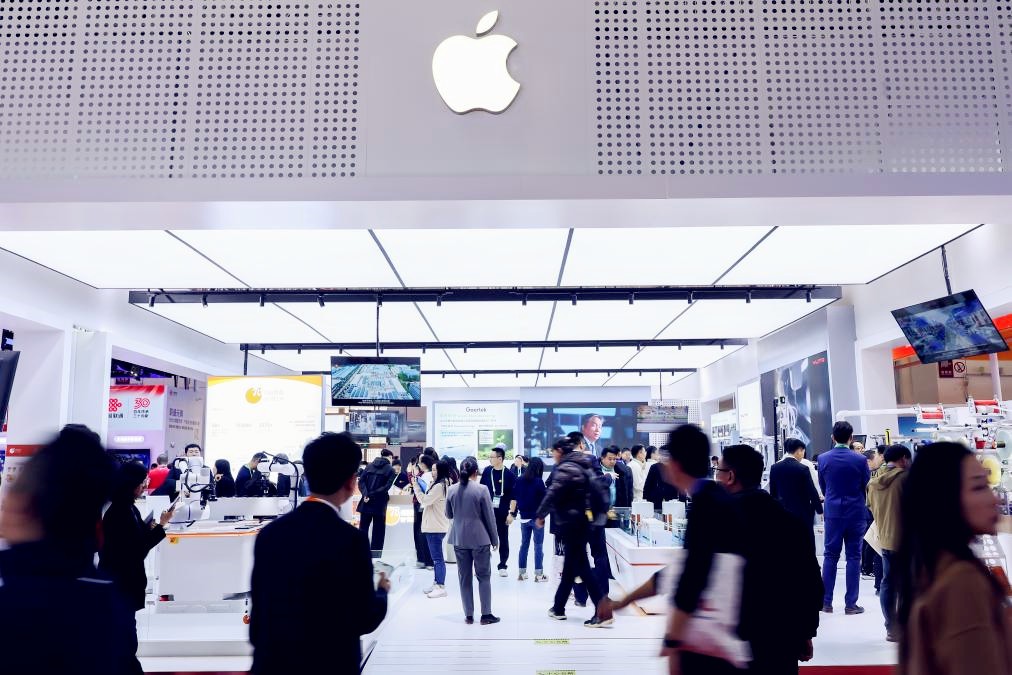
In 2024, at the Digital Technology Chain exhibition area of the second China International Supply Chain Expo, Apple Inc. of the United States showcased its booth alongside four selected Chinese suppliers. Xinhua News Agency reports
Apple’s choice may trigger a major reshuffling of the market.
Bloomberg reported on July 1 that Apple is still only in discussions about purchasing chips from China. But why has such a simple piece of news triggered a sharp sell-off in global chip stocks?
The most straightforward explanation is that Apple genuinely needs memory chips from China. Because the global AI boom has led to a sharp rise in chip prices, Hynex, for example, has an operating profit margin of 72% in the first quarter of this year, while almost all Apple's electronic products are inseparable from memory chips.
For now, Apple has no choice but to raise prices. The entry-level MacBook Neo has seen a price increase of 900 yuan (all currency in this article is in Chinese yuan), the MacBook Air has gone up by 1,500 yuan, and the base‑level iPad in the tablet lineup has risen by 800 yuan… In the past decade, Apple has not implemented such large‑scale price hikes.
The primary reason for Apple’s price hikes is to pass on the increased cost of memory. However, price increases are a double-edged sword—they directly impact sales volume, which in turn affects Apple’s financial performance.
Now, Apple has announced that it intends to collaborate with China’s CXMT and YMTC, which could achieve at least two objectives:
First, it can negotiate prices with Samsung and SK Hynix;
Secondly, Apple is indeed seriously considering purchasing chips from ChangXin Memory and YMTC. After all, Apple CEO Tim Cook has indeed lobbied the U.S. government on this issue in the past.
Moreover, from the perspective of China’s chip industry, there is another layer of significance: as is well known, Apple maintains extremely stringent quality-control standards. The fact that it has chosen to work with ChangXin Memory and Yangtze Memory Technologies Co. fully demonstrates that Chinese chips are reliable, and that China has established a foothold in the global semiconductor market.
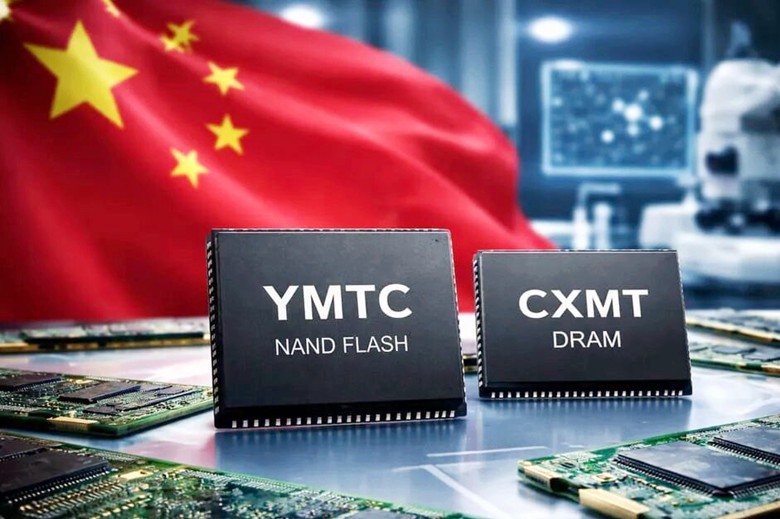
China’s ChangXin Memory and Yangtze Memory Technologies (illustrative diagram). AI-generated images
According to data reported by CCTV News, China’s share of mainstream‑node chip production capacity is expected to exceed 30% by 2025. Moreover, the defining characteristic of Chinese manufacturing is its exceptionally high cost-effectiveness coupled with excellent product quality. At a time when the world is facing a severe semiconductor shortage, China alone boasts a robust and extensive supply chain system capable of ensuring large-scale, stable deliveries.
Based on the foregoing considerations, Chinese chips undoubtedly hold significant practical value for tech giants such as Apple.
In recent years, the United States has consistently implemented a range of policies to restrict the export of chip-related technologies and equipment to China. But as NVIDIA CEO Jensen Huang has said, restrictions—especially when applied to a country of China’s size—will only give rise to even more formidable competitors.
Today, Apple’s move is precisely validating this logic. Despite various attempts by the U.S. government to obstruct it, Apple ultimately voted with its feet; after all, globalized division of labor remains the most cost-effective path, and forced containment will only erode American companies’ competitive edge.
Accordingly, the sharp declines in U.S., Japanese, and South Korean chip stocks become easier to understand—China is emerging as a force to be reckoned with at the global semiconductor table. With Chinese firms wielding an overwhelming advantage in production capacity now entering the fray, the implications for their overseas counterparts go far beyond simply adding another competitor; it suggests that the market may soon undergo a major reshuffling.
Recommended News
Contact Us
- Phone: 0017194050155
- Fax: 0017194050155
- 邮箱:gelcc1@outlook.com
- Mobile phone: 0017194050155
- Address: Room 500, 1234 International Avenue, Washington, D.C. 20001, USA