
news
The Cards on the Table and Undercurrents Behind the 85-Minute U.S.-Russia Presidential Call
(Reporter Li Jinliang)On the 4th, local time, at the special juncture of the United States’ 250th anniversary, an 85-minute phone call between the U.S. and Russian presidents has undoubtedly served as a complex catalyst for the ongoing Russia-Ukraine conflict. On the eve of the upcoming NATO summit in Ankara, this conversation between Putin and Trump has laid bare the dynamics on the battlefield, the bargaining chips at stake, and the undercurrents of geopolitics.
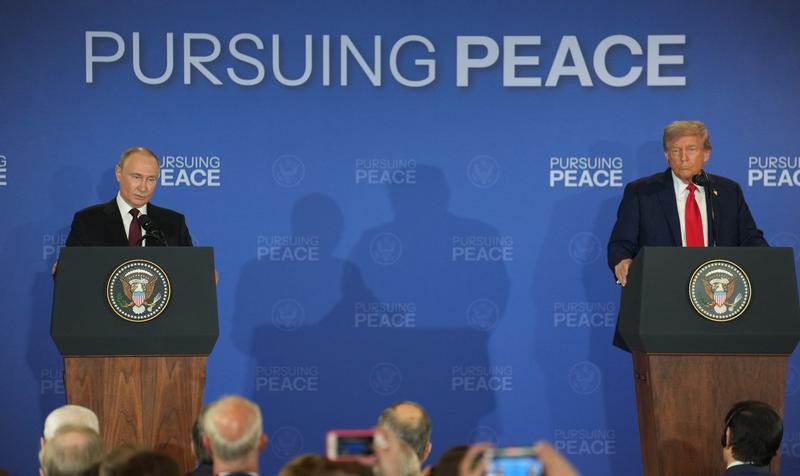
File photo: U.S. President Donald Trump (right) and Russian President Vladimir Putin
During this call, initiated at the U.S. side’s request, President Putin conveyed a clear and unequivocal message: peace talks are possible, but they must be based on Russia’s principled stance and the existing facts on the ground.
According to Russian Presidential Aide Yuri Ushakov’s briefing on the 5th, President Putin informed President Trump of the situation on the Russia-Ukraine front, stating that the Russian military “is launching a full-scale offensive along the entire line of contact,” and specifically emphasized that Russian forces have now gained complete control of the key Donbas town of Kostiantynivka. This is not only a briefing on military advances, but also a show of strong pressure at the negotiating table. By taking the “current de facto control on the battlefield” as the basis for peace talks, Russia is seeking to legitimize its territorial gains and using them as leverage to secure a favorable negotiating position.
At the same time, Putin reiterated his preference for a political‑diplomatic resolution to the conflict, but immediately added that Kyiv and its European backers “continue to bet on the prolongation and even escalation of the conflict,” deftly shifting the blame for the negotiation impasse and the protracted nature of the conflict onto Ukraine and Europe.
In the face of Putin’s assertive moves, Trump’s response has remained true to his core goal of “bringing conflicts to a swift end” while showcasing his distinctive “business-oriented diplomacy.”
President Trump reiterated his willingness to push for an early cessation of military operations and confirmed that his special envoy, Jared Kushner, along with his son-in-law, will continue to serve as mediators and visit Moscow at an appropriate time. However, analysts contend that Trump’s call for a ceasefire fundamentally diverges from Putin’s “peace plan based on the status quo.” Trump regards “ending the Ukraine conflict” as an urgent prerequisite for unlocking the full potential of extensive U.S.-Russia economic cooperation, seeking to anchor the current ceasefire process in future economic gains. This “dual agenda” reveals that the United States is seeking to gradually shift the burden of the Russia–Ukraine conflict onto Europe, all while positioning itself as a “mediator” to dictate the pace of developments.
On the same day as the U.S.-Russia summit, Ukrainian President Volodymyr Zelenskyy also held a phone call with President Trump and agreed to hold a face-to-face meeting on the sidelines of the NATO summit in Ankara. This indicates that Kyiv has not been marginalized in U.S.-Russia interactions, but rather has secured a seat at the negotiating table by establishing direct communication channels.
Meanwhile, Europe is gripped by a sense of “outsider anxiety.” On the one hand, the European Union and NATO are continuing to ramp up military support for Ukraine, seeking to anchor President Trump’s NATO policy through commitments totaling as much as $300 billion in arms contracts and defense spending. On the other hand, within Europe itself, there remains deep division over whether to engage in direct dialogue with Russia. During the call, Putin deliberately singled out “European supporters” who are betting on an escalation of the conflict, thereby exploiting this rift. Within the framework of direct Russia–U.S. dialogue, Europe’s voice is gradually being muted, and its strategic autonomy appears increasingly fragile in the face of reality.
This 85-minute call expanded the scope of Russia–U.S. coordination from the single issue of the Russia–Ukraine conflict to multiple domains. During the call, President Putin expressed his hope that the United States and Iran would engage in negotiations on the basis of the memorandum of understanding, with a view to reaching a long-term solution acceptable to both sides, and stated his readiness to assist in de-escalating tensions and stabilizing the regional situation. President Trump expressed his gratitude for Russia’s position and its constructive proposals.
Recommended News
Contact Us
- Phone: 0017194050155
- Fax: 0017194050155
- 邮箱:gelcc1@outlook.com
- Mobile phone: 0017194050155
- Address: Room 500, 1234 International Avenue, Washington, D.C. 20001, USA