
news
Scholar: Sino-Russian relations enter a new stage of high-level, substantive and institutionalized
Hong Kong China News Agency, May 21 (Reporter Ye Yongcheng)Russian President Vladimir Putin launched his 25th visit to China from May 19 to 20. The heads of state of China and Russia have interacted intensively and achieved fruitful results. The two sides issued two joint statements and signed and announced a total of 40 cooperation documents under the witness of the heads of state. The contents cover further strengthening comprehensive strategic cooperation, deepening good neighborly and friendly cooperation, jointly playing a constructive role in maintaining the global balance of power and improving the international relations system, and carrying out cooperation in the fields of economy, trade and digital economy, education and people to people exchanges, science and technology and innovation, and energy cooperation. Some scholars interviewed pointed out that this marks that Sino-Russian relations have entered a new stage of "high-level, substantive, and institutionalized" and set a model for relations between major powers.
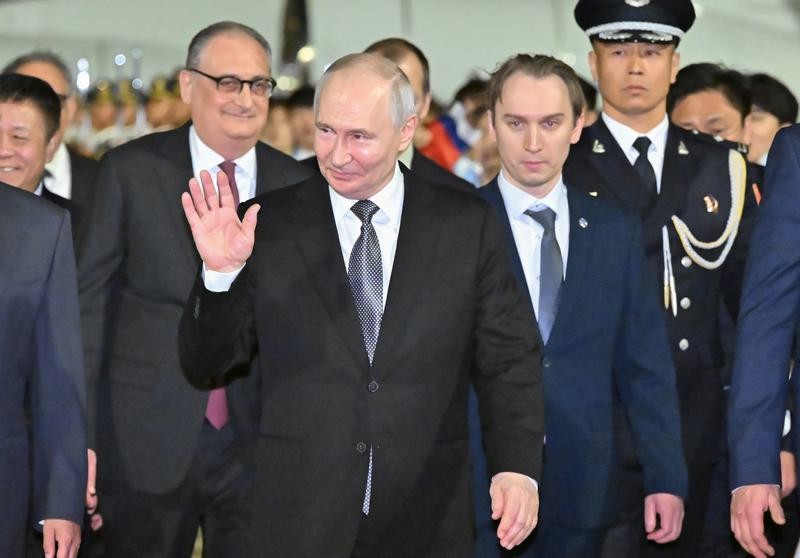
On the evening of May 19, Russian President Vladimir Putin arrived in Beijing aboard his presidential aircraft. Photo source: Xinhua News Agency
This year marks the 30th anniversary of the establishment of the Sino-Russian strategic partnership of cooperation and the 25th anniversary of the signing of the Sino-Russian Treaty of Good-Neighborliness, Friendship and Cooperation. The two heads of state agreed to continue to extend the Sino-Russian Treaty of good-neighborliness, Friendship and Cooperation, and signed and issued a joint statement between the two countries on further strengthening comprehensive strategic cooperation and deepening good-neighborliness, friendship and cooperation.
Tian Dewen, researcher, Russian-Eurasian Institute, Chinese Academy of Social SciencesIn an interview with the Hong Kong China News Agency on the 21st, he said that in terms of strategic cooperation, China and Russia have strong political mutual trust. The joint statement and the extension of the Treaty of Good-Neighborliness and Friendship have consolidated the legal and political foundation, and are in step with multi-polarization and global governance. Relations set an example.
Li Ziguo, director of the Eurasian Institute of the China Institute of International Studies, believes that the continued extension of the treaty shows that Sino-Russian relations have a solid political and legal foundation. Ma Bin, deputy director of the Russian Central Asian Studies Center of the Institute of International Studies of Fudan University, pointed out that China and Russia, both permanent members of the UN Security Council, should provide constructive solutions for regional peace and inject rational and stable forces into global hot issues.
China and Russia have strengthened the overall design of all-round cooperation, and promoted the quality and upgrading of practical cooperation in economic and trade investment, energy and resources, transportation, and scientific and technological innovation. After the talks, the two heads of state witnessed the signing and agreement of 40 cooperation documents in the fields of economy and trade, education, science and technology announced on the spot, covering urban development, cross-border railway construction, controllable nuclear fusion, trade opening, industrial product trade, customs cooperation, Animal and plant quarantine, market supervision, intellectual property rights and other fields. At the same time, we will promote multi-level cooperation in deepening scientific and technological, educational and cultural exchanges.
Liu Chunsheng, Associate Professor, School of International Economics and Trade, Central University of Finance and EconomicsHe pointed out to the Hong Kong China News Agency that Putin's visit to China has promoted the pragmatic deepening of Sino-Russian trade cooperation, not only consolidating traditional trade such as energy and agricultural products, expanding high value-added fields such as new energy and high-end manufacturing, but also through the facilitation of customs clearance and local currency settlement. The construction of mechanisms reduces external risks, helps the expansion and quality of bilateral trade, and consolidates the economic foundation for strategic cooperation between the two countries.
Tian Dewen believes that bilateral trade has exceeded US $200 billion for three consecutive years, energy, interconnection, and high-tech fields have been promoted simultaneously, cooperation documents have promoted the quality and upgrading of practical cooperation, and the pattern of mutual benefit and win-win has become more stable.
This year coincides with the launch of the "China-Russia Education Year". The two heads of state jointly attended the opening ceremony of the "China-Russia Education Year". Today, China-Russia education cooperation is in the ascendant. The scale of two-way study abroad has exceeded 80000, and the two sides have jointly built more than 150 cooperation. For school-running institutions and projects, more and more Chinese and Russian youths have grown up through mutual learning and mutual learning and become the inheritors of friendship.
It is worth noting that under the joint witness of the two heads of state, Chinese Minister of Commerce Wang Wentao and Russian Minister of Economic Development Rishetnikov signed a joint statement on supporting open trade and multilateralism in Beijing.
The joint statement emphasizes that, in the current international economic and trade environment, multilateralism should be firmly upheld, and open and fair trade must be adhered to. Both sides commit to jointly opposing unilateral coercive measures and trade protectionism, and to rejecting trade‑restrictive measures imposed under the pretext of national security, environmental protection, or climate change mitigation.
Both sides believe that economic and trade consultations with third parties should not be directed against the other party. Both sides reaffirmed their support for a multilateral trading system centered on the World Trade Organization, rule-based, non-discriminatory, fair, open, inclusive, equitable, sustainable, and transparent, and committed themselves to advancing bilateral economic and trade cooperation and fostering growth in trade and investment.
Both sides agreed to strengthen coordination and cooperation within such platforms as the Group of Twenty, the Asia-Pacific Economic Cooperation, the BRICS countries, and the Shanghai Cooperation Organization. (The End)
Recommended News
- government approval 2026-04-17
Contact Us
- Phone: 0017194050155
- Fax: 0017194050155
- 邮箱:gelcc1@outlook.com
- Mobile phone: 0017194050155
- Address: Room 500, 1234 International Avenue, Washington, D.C. 20001, USA