
chairman
consultant
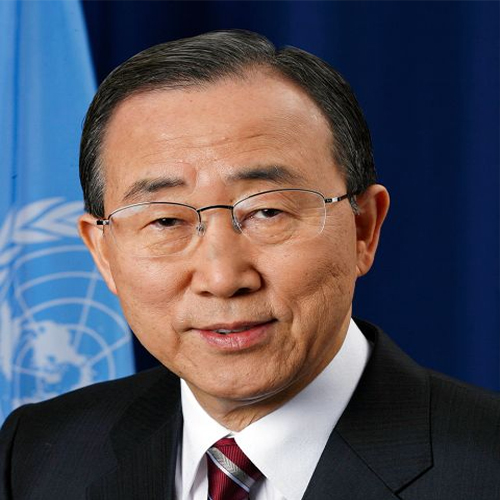
Ban Ki-moon
Before the United NationsSecretary-General
Ban Ki moon is the eighth United Nations Secretary GeneralSecretary-GeneralHis priority is to mobilize world leaders to address numerous new global challenges, including climate change and economic turbulence, pandemics, and increasing pressures related to food, energy, and water. He is committed to becoming a bridge builder, giving voice to the poorest and most vulnerable people in the world, while also striving to strengthen the United Nations itself.
I grew up in war, "Ban Ki moon said," witnessing the United Nations helping my country recover and rebuild. This experience was an important reason for me to devote myself to public serviceSecretary-GeneralI am determined to enable the United Nations to provide concrete and meaningful results, promoting peace, development, and human rights
Ban Ki moon took office on January 1, 2007. The second term began on January 1, 2012 and he resigned on December 31, 2016. His key tasks during his tenure include:
One of the Secretary General's first major initiatives was the 2007 Climate Change Summit and subsequent extensive diplomatic efforts, which helped push this issue to the forefront of the global agenda. Subsequent efforts have focused on the world's major anti-poverty goals, namely the Millennium Development Goals, which have resulted in over $60 billion in pledges, with a particular emphasis on Africa and the new global strategy for women's and children's health. In 2008, during the peak of the food, energy, and economic crises, the Secretary General successfully called on the G20 to provide a $1 trillion financing package for developing countries and took other measures to guide the international community to respond and protect vulnerable groups and the poor.
The Secretary General successfully promoted the establishment of UN Women. This important new institution will strengthen the work of the United Nations in this field. His advocacy for women's rights and gender equality also includes the "Unite to End Violence Against Women" movement, the "Stop Rape Now" initiative, the creation of the "Men's Leadership Network", and the establishment of the new position of Special Representative on Sexual Violence in Conflict. Within the United Nations itself, the Secretary General has increased the number of women in senior management positions by over 40%, reaching the highest level in the organization's history.
The Secretary General is committed to strengthening the peace efforts of the United Nations, including through the "New Horizon" peacekeeping initiative, the Global Field Support Strategy, and the Civilian Capacity Review, a series of steps aimed at increasing the influence of 120000 United Nations "Blue Helmets" personnel operating in conflict zones around the world. The Secretary General has established a Mediation Support Unit and equipped it with new capabilities to facilitate the prevention, management, and resolution of tensions, conflicts, and crises in order to carry out good offices. The work of holding accountable those who violate human rights has been highly valued, such as conducting investigations in Gaza, Guinea, Pakistan, and Sri Lanka, as well as legal proceedings in Lebanon and Cambodia, and advocating for the "responsibility to protect", a new United Nations norm aimed at preventing and stopping genocide and other serious crimes. He also made efforts to strengthen humanitarian response after major disasters in Myanmar (2008), Haiti (2010), and Pakistan (2010), as well as to mobilize United Nations support for democratic transition in North Africa and the Middle East.
The Secretary General has been seeking to revitalize disarmament efforts through the implementation of a five point plan, efforts to break the deadlock in the Conference on Disarmament, and increasing emphasis on nuclear safety and security after the Fukushima Daiichi nuclear disaster in Japan.
The Secretary General has introduced a series of new measures aimed at improving the transparency, effectiveness, and efficiency of the United Nations. These measures include strict regulations on financial information disclosure, signing contracts with senior management, standardizing business practices and service conditions, adopting International Public Sector Accounting Standards, and continuing to invest in information technology and personnel development.
The Secretary General was born on June 13, 1944 in the Republic of Korea. Obtained a Bachelor's degree in International Relations from Seoul National University in 1970. In 1985, he obtained a Master's degree in Public Administration from the Kennedy School of Government at Harvard University.
When elected as Secretary General, Mr. Pan was the Minister of Foreign Affairs and Trade of South Korea. During his 37 year tenure in the department, he was stationed in New Delhi, Washington D.C., and Vienna, and held various positions including Presidential Foreign Policy Advisor, Presidential National Security Advisor, Deputy Policy Planning Officer at the Ministry of Foreign Affairs and Trade, and Director of the Americas Bureau.
Mr. Pan's relationship with the United Nations can be traced back to his tenure at the United Nations Office of the Ministry of Foreign Affairs in 1975. Since then, his relevant work experience has expanded year by year, including the position of Chairman of the Preparatory Commission for the Comprehensive Nuclear Test Ban Treaty Organization and Director of the Office of the President of the United Nations General Assembly held by the Republic of Korea from 2001 to 2002. Mr. Pan also actively participated in resolving issues related to inter Korean relations.
The Secretary General speaks English, French, and Korean. He met his wife Liu (Pan) Chunze in high school in 1962 and currently has one son and two daughters, as well as four grandchildren. Since 2007, Mrs. Pan has been committed to solving women's and children's health problems, including autism, eliminating violence against women, and promoting campaigns to prevent mother to child transmission of HIV/AIDS.
Recommended News
- government approval 2026-04-17
Contact Us
- Phone: 0017194050155
- Fax: 0017194050155
- 邮箱:gelcc1@outlook.com
- Mobile phone: 0017194050155
- Address: Room 500, 1234 International Avenue, Washington, D.C. 20001, USA