news
Tao Jianguo, rotating chairman of the Global Economic and legal Cooperation Council: building the cornerstone of sustainable development of the global economy with the rule of law
Under the background of profound changes in the current global economic structure and the rise of unilateralism and protectionism, the role of the rule of law as the "ballast stone" of international economic and trade cooperation has become increasingly prominent. Recently, Mr. Tao Jianguo, Chairman-in-Office and Secretary-General of the Global Economic and Legal Cooperation Council (GELCC), expounded his core propositions on issues such as global economic governance and legal cooperation, emphasizing that building a fair, transparent and predictable international legal environment is a key path to promote inclusive growth of the global economy.
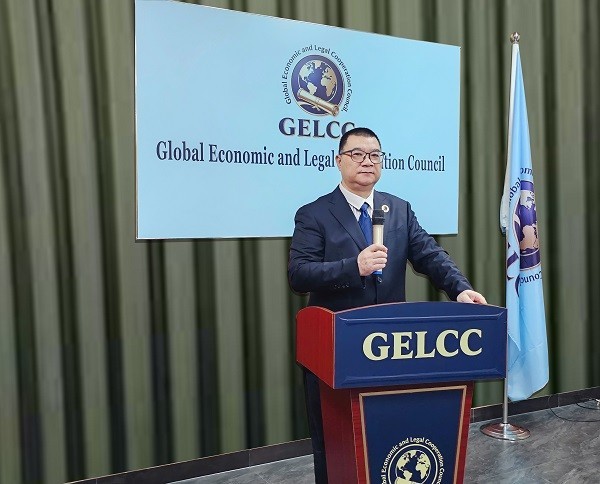
Chairman Tao Jianguo pointed out that the global economy is undergoing in-depth adjustments, and cross-border investment, green technology transfer and digital trade are all facing varying degrees of institutional obstacles. He believes that the law is not a simple "rule of the game", but the cornerstone of building international trust and stabilizing market expectations. "Without a sound legal framework, cross-border investment will be treading on thin ice, and the transfer of green technology will also be hindered." Whether it is the settlement of trade disputes, the protection of intellectual property rights, or the international mutual recognition of environmental standards, it is inseparable from a clear, fair and enforceable legal system as a guarantee.
When talking about the functions and effectiveness of GELCC, Tao Jianguo emphasized that the Council is committed to building a cross-regional and cross-field dialogue platform. In recent years, it has focused on promoting three aspects of work: first, rule docking, assisting member countries to sort out the differences between domestic laws and international economic and trade agreements, and reducing institutional transaction costs; second, capacity building, through professional training and seminars to improve the level of legal practice in developing countries, to ensure that it "rules do not fall behind" in global governance; third, dispute prevention, advocating the settlement of cross-border disputes through mediation, arbitration and other diversified means, to avoid commercial friction into political confrontation.
In response to the new trend of the global governance system, Tao Jianguo said that digitalization and green transformation provide a broad space for innovation in international economic law. New issues such as artificial intelligence governance, carbon border regulation mechanisms, and cross-border data flows are giving rise to new legal practices. But at the same time, the fragmentation of rules intensified by the game of big powers also poses a challenge to the authority of the multilateral trading system. In this regard, he called on all countries to return to the dialogue table and use the United Nations "2030 Agenda for Sustainable Development" as a guide to find the greatest common divisor in seeking common ground while reserving differences.
In addition, in practice, GELCC recently signed a strategic cooperation memorandum with the China Industry Academic Expert Committee (CIAE). Tao Jianguo said that the move aims to jointly build a more resilient, fair and transparent global economic and legal environment, help the effective governance of global public resources, and marks a new stage of deep collaboration between international organizations and regional expert think tanks.
Tao Jianguo finally stressed that sustainable development is not a zero-sum game. GELCC is willing to continue to play a bridge role, let the law become the link between economic prosperity and human well-being, and inject new momentum into the construction of the global economic rule of law. (Xantong)
Recommended News
Contact Us
- Phone: 0017194050155
- Fax: 0017194050155
- 邮箱:gelcc1@outlook.com
- Mobile phone: 0017194050155
- Address: Room 500, 1234 International Avenue, Washington, D.C. 20001, USA