
news
Less than two weeks after the intervention of the United States and Japan, has the yen been "hit back to its original state"?
Hong Kong News Network, August 13-The rare joint intervention in the foreign exchange market between the United States and Japan lasted less than two weeks, and the yen was once again "hit back to its original state"? On August 11, Japan's Kyodo News Agency and the Tokyo Broadcasting Corporation reported that the yen had fallen back to the 159 yen per dollar range, and about half of the appreciation brought about by the massive intervention was erased in less than two weeks. The renewed depreciation of the yen not only exposed Japan's deep-rooted structural problems, but also triggered a new round of public scrutiny of Japan's economic prospects. The 12-day Nikkei Asian Review review article, dating from the MacArthur era, reviews U.S. economic intervention in Japan after World War II. The article believes that Japan can not solve the problem on its own, seeking the United States to intervene in the yen, calling on the United States to intervene in the yen itself.
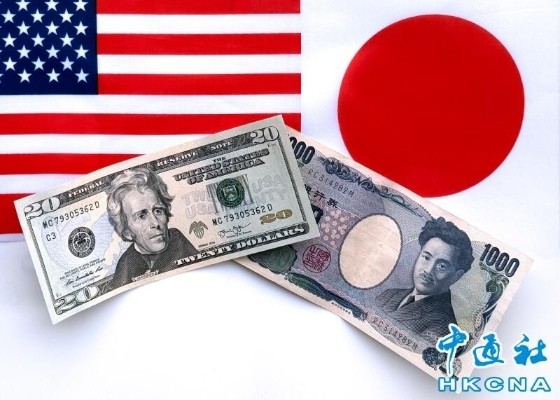
Photograph: Archives of Hong Kong China News Service
Prices rebound to 159 yen range from 155 yen
According to the "Global Times" report, foreign exchange market data showed that during the Asian trading session on August 12, the yen 159.4 yen against the US dollar, close to the 160 yen threshold that the market regards as a key warning line for policy intervention.
In July, the yen weakened sharply again. Japanese Finance Minister Satsushi Katayama and top foreign exchange officer Mimura had previously warned of a speculative sell-off in the yen. Subsequently, the Japanese authorities implemented exchange rate intervention to buy the yen, but the decline has not been reversed.
"Tokyo Fa du Shimbun" reported on the 11th that on July 31, the United States and Japan made a rare joint foreign exchange intervention to raise the yen exchange rate. Including phased actions, the size of the intervention by the Japanese government and the Bank of Japan could reach 11 trillion to 14 trillion yen, possibly the largest in history. Driven by this unusually large-scale move, the yen briefly rebounded strongly during trading on August 3, reaching about 155 yen per dollar, showing significant short-term appreciation.
However, the help from the intervention did not last long. According to the "Tokyo Baoto News" report, only a few days later, the market is facing the pressure of selling the yen again. As the yen falls back to the 159-day interval,.
"Fears of a structural recession have not been dispelled"
The yen weakened again, mainly due to U.S. interest rate expectations. Kyodo news agency analysis said that increased uncertainty in the Middle East pushed up crude oil futures prices on August 10. The market generally believes that the Fed may raise interest rates in September to curb inflation. Trading to sell yen and buy dollars regained dominance due to the difference in interest rates between Japan and the United States.
However, some Japanese domestic media believe that the interest rate difference is not enough to explain the continued weakness of the yen. The dollar has not risen strongly in line with other currencies, which means that the current currency market volatility is not a "broad dollar strength", but a weakening of the yen relative to other major currencies.
Sadness and skepticism are spreading in Japan, where the yen was once seen as a risk-aventive asset and is now facing a crisis of confidence. Some netizens pointed out. This is due to the continuing concerns of a structural recession in Japan. "As long as the fundamental problem is not solved, the depreciation of the yen will be difficult to change."
Many market views also point out that the Japanese government's push for fiscal expansion while intervening in the exchange rate is tantamount to "stepping on the accelerator and the brakes at the same time", exposing a clear policy imbalance. The recent sharp increase in the defense budget and other policies has further exacerbated market concerns about the risk of Japan's fiscal imbalance.
In fact, at the beginning of this intervention, the Japanese market had already judged that "intervention is difficult to change the long-term direction". Bloomberg previously quoted Sakai, head of foreign exchange trading at Mitsubishi UFJ Trust Bank, as saying that market concerns about Japan's fiscal expansion and the speed of the Bank of Japan's interest rate hikes have not disappeared, so more currency intervention can only change the speed and magnitude of the yen's depreciation, and it is difficult to change the long-term trend.
How long can the "fresh period" of coordinated intervention between Japan and the United States last?
Industry insiders believe that 160 the yen support level may be maintained in the short term, the yen may temporarily avoid falling back to the level of around 164 yen before the intervention. But as the effects of the intervention continue to wane, so do market questions about its duration. Nomura Research Institute executive economist Nosuhide Muonei said that what is more worthy of attention now is: "How long can the'shelf life' of Japan-US coordinated intervention last?""
"All the intervention measures have curbed the market, but have not changed the basic law of the financial market-capital always flows back to where it is highest ...... As long as the cost of capital in Japan is lower than the return on overseas investment, arbitrage trading will be active again. "Japan Financial Services Group Monex Group expert Jesper Cole said.
This also means that whether the yen can be truly stable in the future ultimately depends on whether Japan can change the situation of continuous capital flow overseas. At present, the market is closely watching the Bank of Japan's monetary policy meeting in September. "Without further policy action, it is likely that the yen will struggle to escape its weakness in the current environment, with the impact of a new round of exchange rate intervention largely vanishing," said Alex Cohen, currency strategist at Bank of America. ""
However, from a long-term perspective, the attractiveness of the yen may not only depend on the level of interest rates. Credit Agricole, a U.S. corporate and investment bank, told CNBC that the deeper problem is the "asymmetry of investment capacity" between the United States and Japan ". The United States continues to make large-scale investments in artificial intelligence and other areas, and continues to attract capital inflows; at the same time, the public-private investment promoted by Prime Minister Takaichi Zaomiu has not yet been fully implemented. The agency said: "To reverse the weakening of the yen, a rate hike is not necessary, but to expand investment." "This means that in order for the yen to continue to appreciate, Japanese assets themselves must become more attractive, encouraging domestic savings to stay at home rather than flowing overseas in pursuit of higher returns.
From the perspective of Japanese public opinion, the question may no longer be whether the yen can stabilize, but whether Japan can still rely on its own policies to maintain market trust in its economic prospects. 12, the Nikkei Asian Review reviewed Japan's history of seeking US help to stabilize the yen during the Asian financial crisis in 1998, and compared the joint intervention to that of that year. The article believes that Japan's need to rely on the United States to stabilize the currency market has reflected its difficulty in relying on its own policies to reverse the depreciation of the yen, and this "seeking help" is a more deserved setback. (End)
Recommended News
Contact Us
- Phone: 0017194050155
- Fax: 0017194050155
- 邮箱:gelcc1@outlook.com
- Mobile phone: 0017194050155
- Address: Room 500, 1234 International Avenue, Washington, D.C. 20001, USA