
news
Spanish refugee crisis shocks European politics; divisions within EU re-emerge
Spain’s North African enclave of Ceuta has recently experienced a “smuggling wave,” with tens of thousands of migrants entering via the Moroccan coastal route, triggering a large-scale refugee crisis. Although most illegal migrants have been returned to Morocco, this has been the most serious border incident in the European Union in recent years, shaking European politics and once again exposing the deep divisions among member states on the issue of migration.
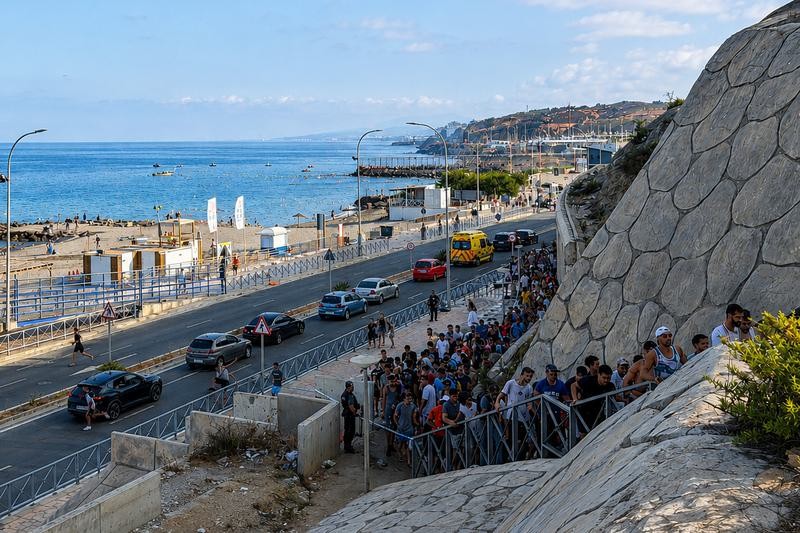
On July 30, illegal immigrants entered Spain’s Ceuta enclave.
An Illegal Immigration Crisis Triggered by Misinterpretation
On July 31, Spanish media, citing government data, reported that approximately 50,000 people had entered Ceuta from Morocco in the past 24 hours. This smuggling operation accounts for 60% of Ceuta’s population, making it one of the most serious sudden-border incidents in the European Union in recent years. As of August 2, the death toll from the incident has risen to 72.
Why is there such a large influx of illegal immigrants into Ceuta?
According to reports, Ceuta is located in northwestern Africa, adjacent to Morocco, and covers an area of approximately 18.5 square kilometers. It is one of Spain’s two enclaves in North Africa; the other is Melilla. Due to its unique geographical location, in recent years a large number of irregular migrants have attempted to enter Ceuta by crossing the border fence or swimming across the sea, subsequently heading to mainland Spain and other European countries.
In early July this year, Spain’s Supreme Court issued a judicial ruling stating that illegal immigrants who cross the land border fences into Ceuta or Melilla may be immediately expelled on the spot; however, migrants who enter by sea—whether by swimming or using flotation devices—may not be deported without prior legal review and must complete all relevant judicial procedures, including asylum applications and identity verification.
The rulingIts original intent was to safeguard the rights of migrants through procedural means, rather than to confer residency, nor did it imply that Spain had abandoned its right to expel them. However, the ruling was misinterpreted as “as long as you swim into Ceuta, you can stay in Spain and eventually obtain legal status,” and it quickly went viral on social media.
According to the Financial Times, the primary participants in this wave of smuggling are young Moroccan men. Many people learned to swim in advance, purchased wetsuits and waterproof phone cases, and headed to the border after dawn on July 30. During this period, even social media shared real-time routes, rapidly disseminating a wealth of information.
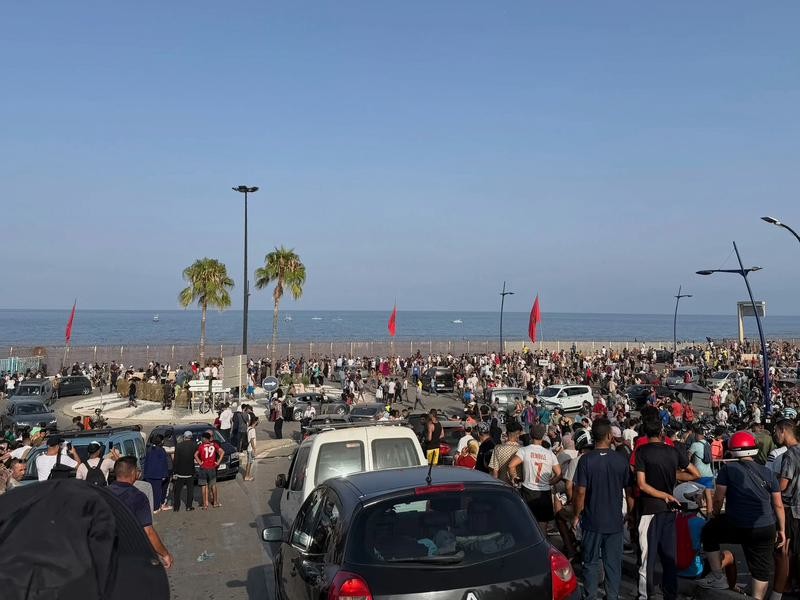
On July 30, people gathered on the Moroccan side of the border between Morocco and Spain’s North African enclave of Ceuta, preparing to cross into Ceuta.
Mohammed Zakaria Abu Zahab, a professor at Mohammed V University in Morocco, argues that human trafficking networks perpetuate false narratives—such as “open borders” and “granting residency upon entry”—by disseminating misinformation on social media, thereby misleading many young people.
Furthermore, some analysts believe that this large-scale “wave of migration” may be linked to the Spanish government’s recent launch of a regularization program for undocumented immigrants, as well as the possibility of stricter immigration controls following the change in the majority party in the Spanish Parliament.
This crisis has deepened the divisions within Europe.
Following the Ceuta migration crisis, Spain urgently dispatched troops to coordinate with the Civil Guard in implementing a response and swiftly engaged in negotiations with Morocco for the repatriation of migrants. As of August 1, the government has confirmed that 48,300 people have returned, and no one has been permitted to travel to mainland Spain. Installation of new interception facilities has begun at the Ceuta border breakwater.
Although the Spanish government swiftly restored order at the border and repatriated the vast majority of people within 48 hours, the scars left by this turmoil are only just beginning to emerge. The BBC reported that this incident has shaken European politics, once again exposing the deep divisions among countries over immigration.
On July 31, Italian Prime Minister Giorgia Meloni announced the suspension of the Schengen free-movement regime with Spain and the reinstatement of border controls. French President Emmanuel Macron stated that Ceuta cannot freely travel to “other parts of the Schengen Area” and has ordered enhanced border controls along the French-Spanish frontier. German Chancellor Merkel called on the Spanish government to swiftly bring the situation under control and “protect the EU’s external borders.”
On August 1, the Italian Prime Minister’s Office issued a statement announcing that 22 EU leaders had signed a joint letter and submitted it to the EU’s governing bodies, expressing “grave concern” over the situation in Ceuta. The letter underscored the need to prevent disorderly and illegal border crossings, eliminate all factors that might encourage unauthorized entry, and ensure that the EU adopts a unified and effective response.
According to reports, in addition to Meloni, the signatories include the leaders of Germany, Austria, Belgium, Bulgaria, Croatia, Cyprus, the Czech Republic, Denmark, Estonia, Finland, Greece, Hungary, Latvia, Lithuania, Malta, the Netherlands, Poland, Romania, Slovakia, Slovenia, and Sweden.
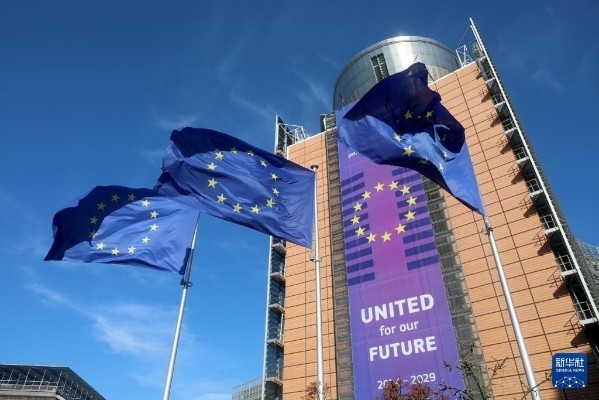
Data map for the EU flag.
Following repeated calls, Irish Prime Minister and EU Council President Micheál Martin announced that the European Union will convene a video conference on August 4 to discuss the recent migration crisis facing Ceuta.
On August 1, Spanish Prime Minister Pedro Sánchez wrote to European Commission President Ursula von der Leyen, criticizing certain EU member states for “choosing to attack Spain and calling for its temporary exclusion from the Schengen Area.” This attitude, “driven by prejudice, fake news, ignorance, or political interests,” not only violates European law, humanitarian law, and the principle of EU solidarity, but also undermines Europe’s long-term interests. Spain has expressed “grave concern,” and the European Union cannot afford such a “selfish, confrontational, and illegal response.”
Analysts point out that at the heart of this political stalemate lies the long-standing divide within the European Union over responsibility for migration. Sanchez, representing border states, called for a collective sharing of the burden; meanwhile, leaders from 22 countries turned their criticism toward Spain’s policies themselves, deeming them insufficiently tough. The emergency meeting on the 4th will mark the first formal clash of positions between the two sides. This outcome will directly affect the EU’s future border coordination and the trajectory of the Schengen framework.
Recommended News
Contact Us
- Phone: 0017194050155
- Fax: 0017194050155
- 邮箱:gelcc1@outlook.com
- Mobile phone: 0017194050155
- Address: Room 500, 1234 International Avenue, Washington, D.C. 20001, USA