
news
Is the yen plunging "active" or "passive"?
(Reporter Li Jinliang) Recently, the exchange rate of the yen against the US dollar fell below the 162 mark, setting a new low in the past 40 years since 1986. This currency, once regarded as a "safe haven", has now become "the world's weakest currency". The Japanese government used a record 11.73 trillion yen to intervene in the market and raised interest rates to 1%, but still failed to stop the decline. Is this near-out-of-control devaluation a policy choice based on internal demand, or is it a passive tolerance under the financial game of big powers?
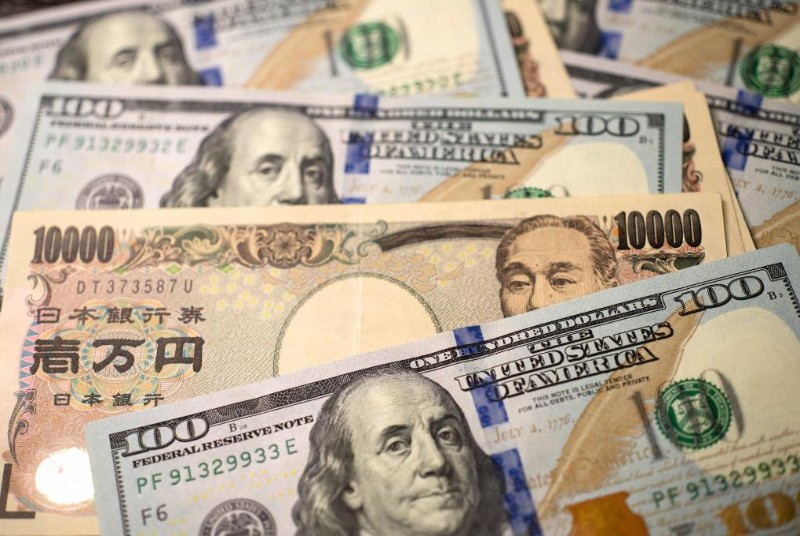
This is a Japanese yen and dollar note taken on April 20, 2022 in Tokyo, Japan. Xinhua News Agency Data Map
On the surface, the sharp fall of the yen has a strong "active" color, which is rooted in the serious mismatch between the aggressive fiscal policy of the Japanese government and the prudent monetary policy of the central bank.
The fight between "tight money" and "wide finance" is the core sticking point. On the one hand, the Bank of Japan struggled to raise interest rates to 1 per cent and used huge sums of money to intervene in the currency market in order to curb devaluation and inflation. But on the other hand, Takaomiao's cabinet has launched a huge investment plan totaling 370 trillion yen, issuing bonds on a large scale for fiscal expansion. This policy mix sends an extremely dangerous signal to the market: with Japan's government debt as a share of GDP as high as 240 per cent, aggressive fiscal spending is seriously overstretching the country's credit. The market cast a vote of no confidence with its "feet", and the boost to the yen from the interest rate hike was completely swallowed up by the negative impact on the financial side.
Analysts compare this phenomenon to the "Truss moment" in the UK in 2022, when the then British Prime Minister Truss forced a tax cut plan that lacked financial support, which eventually caused severe market turmoil. Today, the Japanese government subsidizes semiconductors and military industry in the name of "economic security", which is generally regarded as a kind of political speculation in exchange for votes. This endogenous policy confusion is the "active" force driving the depreciation of the yen.
However, it is not comprehensive enough to blame the devaluation of the yen entirely on Japan's internal affairs. At a deeper level, the yen is passively under intense pressure from U.S. monetary policy. The huge interest rate differential between the United States and Japan is the "noose" on the yen ".
While the Fed keeps interest rates high at 3.5 to 3.75 per cent, even if Japan raises interest rates to 1 per cent, the spread between the two is still hundreds of basis points. This has led to a large and persistent yen carry trade: investors borrow low-cost yen and convert it into dollars to buy high-yielding U.S. debt or other dollar assets, thus selling the yen.
A number of institutional analysis pointed out that the weakness of the yen is not only determined by long-term spreads, the market's expected differentiation of the short-term monetary policy path is more critical. As long as the market believes that the Federal Reserve will maintain tightening and the Bank of Japan is slow to raise interest rates, it will be difficult for the yen to escape the fate of being sold. Goldman Sachs is predicting that the yen's depreciation trend is still not over. From this point of view, the depreciation of the yen is more of the Fed's monetary policy "collateral damage", is a passive, dominated by external forces.
In addition, as a country highly dependent on imports of resources and energy, the rise in international energy prices has directly worsened its terms of trade, leading to soaring import costs and further increasing the depreciation pressure on the yen. This devaluation, triggered by external shocks, is also a passive bear.
This situation has pushed Japan into a policy dilemma: continuing to raise interest rates could crush the already heavy fiscal burden and pour cold water on the fragile economic recovery; maintaining easing would mean letting the yen depreciate and enduring the erosion of imported inflation on residential purchasing power and corporate profits.
More worryingly, the crisis could spill over globally. As the largest overseas holder of U.S. Treasury bonds, if Japan continues to sell U.S. bonds in order to intervene in the foreign exchange market, it may trigger turmoil in the U.S. bond market, push up U.S. Treasury yields, and even constitute an "earthquake-magnitude" impact on global financial markets.
Recommended News
Contact Us
- Phone: 0017194050155
- Fax: 0017194050155
- 邮箱:gelcc1@outlook.com
- Mobile phone: 0017194050155
- Address: Room 500, 1234 International Avenue, Washington, D.C. 20001, USA