
news
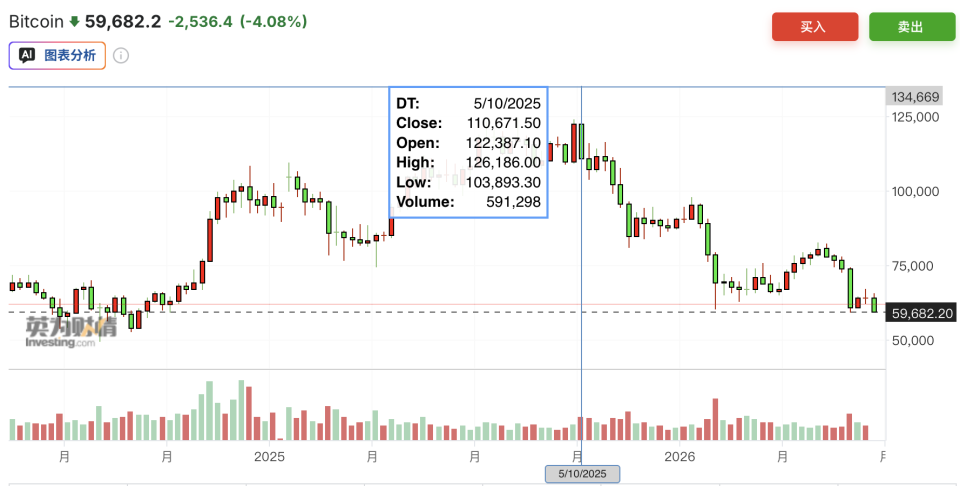
Bitcoin falls below 60000! Who's going to catch the plunge when Wall Street takes over the market after the AI sucks money out and retail investors are absent?
Bitcoin is workingInstitutional transformationPay the price. Shrinking retail buying, continued outflows of ETF funds, and increased potential selling pressure on corporate position holders, coupledAI infrastructure investmentContinuing to siphon risk asset funds, this round of Bitcoin decline presents structural characteristics that are different from previous cycles.
Bitcoin once fell 5.4 percent in intraday trading, hitting $59023, the lowest level since October 2024. The last time it fell below $60000 was in early June this year. The current price has fallen by about 50% from its historical high in October 20205.
According to CoinGlass data, in the past 24 hours, about $0.8 billion long positions in the cryptocurrency market have been forced to close. According to Deribit, about $10 billion Bitcoin options expired quarterly on Friday.
Deutsche BankThe key difference between this round of decline and previous crypto market sell-offs is that new retail buying has nearly dried up, while institutional demand is losing momentum at the same time, and capital is shifting heavily to AI-related investments.
Deutsche Bank research analyst Marion Laboure said that when ETF allocators and corporate financial managers withdraw or transfer funds elsewhere, prices fall faster and more mechanically than in previous retail-led cycles.
At the same time, the Fed's shift to a hawkish stance-with some economists expecting two more rate hikes this year-further threatens the liquidity tailwinds that have underpinned risky assets in recent years.
Retail exit, ETFs become price amplifiers
The buyer structure of the Bitcoin market has undergone a fundamental shift.
Laboure pointed out that retail investors have acted as an important undertaking force in previous sharp falls, but this group has been largely absent in the current cycle. Instead, ETF allocators and corporate coffers-and this group of buyers is increasingly weighing bitcoin alongside AI investments.
ETF capital flows have become a key driver of Bitcoin's price movements, which means that the amplification effect of capital flows on the decline is completely symmetrical to the previous mechanism by which capital inflows drove the rise.
According to the Laboure, the ETF tracking bitcoin has suffered a net outflow of more than $6 billion, the longest continuous outflow since 2024.
AI infrastructure investment siphons crypto funds
Capital leaving the crypto market is finding a new home, rather than staying on the sidelines.
Deutsche Bank pointed out that the largest hyperscale cloud computing operator in the United States is expected to spend more than $700 billion on AI infrastructure this year.
Crypto assets share the same category of marginal buyers as growth stocks-investors looking for upside returns on highly volatile assets. Once market confidence declines, positions in the entire basket of risk assets will be cut simultaneously.
If this rotation of funds to the AI is structural rather than temporary, the drag on crypto demand is likely to last longer than any previous downward cycle.
Strategy reduction raises concerns about leveraged positions
The traction of institutional behavior on market sentiment is rising.
Earlier this month, Strategy disclosed that it had sold 32 bitcoins-the first time it had disposed of a position since 2022. Although the size of the deal is insignificant relative to its large position, its symbolism has suddenly strained the market's sensitive nerves: highly leveraged corporate position holders may be transformed from buyers to sellers.
Deutsche Bank said that even if the company subsequently resumed buying, the episode still deeply revealed the market's high sensitivity to institutional movements.
Laboure noted that Bitcoin is currently trading below the Strategy average holding cost of $75,699, and the market has begun to price in the possibility of leveraged corporate position holders being forced to sell. "we expect this doubt to persist," she said.
At the same time, Strategy common stock fell for the sixth consecutive trading day, falling to its lowest level since February 2024; the real yield on its preferred securities rose to about 14%.
Regulatory legislative progress or an upward catalyst
As downward pressure continues, market watchers are looking to Washington for potential boosters.
Steve Kurz, global co-head of digital assets at Galaxy, said that positive policy developments may be the trigger for a bitcoin rally.
The market is currently focused on the so-called 《Clear Bill(Clarity Act)-The bill aims to establish the Commodity Futures Trading Commission (CFTC) as the primary regulator for most areas of the crypto industry, while the Securities and Exchange Commission (SEC) retains regulatory authority over digital securities.
"The current situation in Washington is very tactical, and while everyone likes to set the probability of passing legislation such as the Clarity Act, the reality is that the will to move the legislation is there and the legislative calendar is set," Kurz said. These two realities are colliding, and the market is likely to remain in a highly tactical environment."
Recommended News
Contact Us
- Phone: 0017194050155
- Fax: 0017194050155
- 邮箱:gelcc1@outlook.com
- Mobile phone: 0017194050155
- Address: Room 500, 1234 International Avenue, Washington, D.C. 20001, USA